
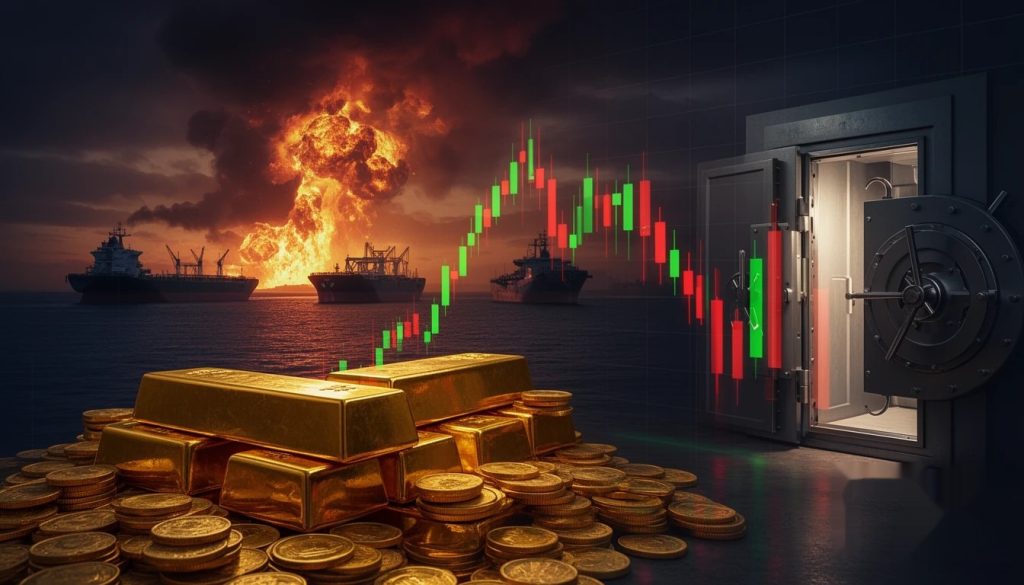
# When geopolitics pushes gold back: the lessons of a high-tension week
Why gold and silver are pulling back despite an unstable world
Gold has fallen 3% in a week, silver has plunged nearly 7%. And yet the world has never seemed so unstable.
The week of 20 April 2026 will be remembered as a textbook case for any precious metals investor. As tensions between the United States and Iran over the Strait of Hormuz enter their ninth week, and as the International Energy Agency describes this crisis as the largest energy shock ever recorded, the gold price has paradoxically pulled back to settle around 4,708 dollars an ounce this Friday 25 April.
A paradox? No. An implacable market mechanism that must be understood in order to be better positioned.
The inflationary trap of the Strait of Hormuz
The effective closure of the Strait of Hormuz has propelled oil prices to levels unseen since 2022, reviving the spectre of lasting inflation. And when inflation takes off again, markets anticipate monetary tightening. The Fed, which is holding its policy rates at 3.50-3.75%, now shows a near-zero probability of an April cut according to CME FedWatch. A Reuters poll of economists pushes the first cut back to the end of 2026, if not beyond.
This prospect of high rates weighs mechanically on gold and silver, non-yielding assets that lose relative attractiveness against sovereign bonds.
The ounce of gold: a correction, not a reversal
Let us recall the facts: the gold price reached its all-time high at 5,595 dollars on 29 January 2026. At 4,708 dollars, we are admittedly 15% below that record, but the ounce remains at levels nobody imagined eighteen months ago. Institutional year-end forecasts range between 5,400 dollars according to Goldman Sachs and 6,300 dollars according to J.P. Morgan, while Union Bancaire Privée maintains its target at 6,000 dollars, reaffirmed on 13 April.
Buying gold at these levels remains, for most analysts, a coherent wealth decision over the medium term, particularly in a context of persistent geopolitical uncertainty.
Silver under pressure, but structurally sound
Silver suffered more this week, falling below 76 dollars an ounce, a pullback of nearly 7%. Its hybrid status, both a precious metal and an industrial metal, makes it more vulnerable to fears of an economic slowdown linked to the energy shock. Yet the gold/silver ratio is holding around 59-61 to 1, well below the long-term historical average of 70 to 1.
This means that, despite its correction, silver retains remarkable relative strength against the yellow metal. Over twelve months, the white metal has gained more than 45 dollars an ounce, a performance very few traditional assets can claim.
Central banks: the signal that does not lie
While markets hesitate, central banks keep accumulating gold bars. According to the World Gold Council, they remained net buyers in February 2026, confirming an uninterrupted trend stretching back several years. Poland leads the way with more than 20 tonnes acquired since January, as part of a strategic plan targeting 700 tonnes of reserves, an approach linked to security concerns on NATO’s eastern flank.
China, Uzbekistan and several Central Asian economies are also accelerating their purchases, viewing gold as a reserve asset beyond the reach of any foreign jurisdiction. Forecasts point to 800 to 850 tonnes of institutional buying for 2026 as a whole, a considerable volume that maintains a structural floor under the prices of gold coins and gold bars.
The Federal Reserve meeting on 29 April: a catalyst to watch
The next Federal Reserve decision, expected on 29 April, will be the last before Jerome Powell’s term as chair of the institution comes to an end. While no rate move is anticipated, the tone of the statement and the inflation projections will be decisive for the entire precious metals market.
Any signal of prolonged patience could temporarily penalise prices, while an opening toward future easing would relaunch the bullish dynamic.
For precious metals investors in Belgium and Europe, this period of consolidation represents a rare window of opportunity to strengthen positions at levels below the January peaks. Market history teaches us that these pullback phases, when they occur within a structural bull cycle, are precisely the moments when the wisest decisions are made.
At Gold & Silver Company, we track these dynamics in real time to offer you the best buying and selling conditions, with full transparency on prices and a technical expertise that few players in Europe can match. If you would like to understand how to position precious metals within your wealth strategy, our teams are available for a no-obligation conversation, at the agency or through an appointment.
Anaïs, Gold Broker & Wealth Manager
*Updated on 27 September 2026.*
Frequently asked questions about gold
Why is gold falling despite geopolitical tensions?
The paradox of the week of 20 April 2026 is explained by an implacable market mechanism. The effective closure of the Strait of Hormuz propelled oil prices to their highest levels since 2022, reviving the spectre of lasting inflation. When inflation takes off again, markets anticipate monetary tightening rather than safe-haven buying. The Fed, holding its policy rates at 3.50-3.75%, now shows a near-zero probability of an April cut according to CME FedWatch, and a Reuters poll pushes the first cut back to the end of 2026, if not beyond. This prospect of durably high rates weighs mechanically on the gold price and on silver, non-yielding assets that lose relative attractiveness against sovereign bonds, even when the geopolitical backdrop remains tense.
How does the Strait of Hormuz crisis affect precious metals?
The closure of the Strait of Hormuz, now in its ninth week, has been described by the International Energy Agency as the largest energy shock ever recorded. Oil prices have reached levels unseen since 2022, and that shock transmits itself to precious metals through two opposing channels. The first is inflationary: costlier energy revives inflation, which pushes central banks toward tighter policy, a headwind for gold and silver. The second is defensive: persistent geopolitical uncertainty strengthens the case for holding tangible assets that protect purchasing power over time. This week, the first channel dominated, sending gold down 3% and silver down nearly 7%. For investors, understanding which channel prevails at any given moment is the key to positioning intelligently rather than reacting emotionally to headlines.
Is the drop in the gold price a trend reversal?
No, and the facts deserve to be restated calmly. The gold price reached its all-time high at 5,595 dollars on 29 January 2026. At around 4,708 dollars this Friday 25 April, the ounce sits admittedly 15% below that record, but it remains at levels nobody imagined eighteen months ago. Institutional year-end forecasts are anything but bearish: between 5,400 dollars according to Goldman Sachs and 6,300 dollars according to J.P. Morgan, while Union Bancaire Privée maintains its 6,000-dollar target, reaffirmed on 13 April. What we are seeing is therefore a correction inside a structural bull cycle, not a reversal. For most analysts, buying gold at these levels remains a coherent wealth decision over the medium term, particularly in a context of persistent geopolitical uncertainty.
Why has silver fallen more than gold this week?
Silver dropped below 76 dollars an ounce, a pullback of nearly 7% in a single week, roughly double the decline recorded by gold. The explanation lies in its hybrid status: silver is both a precious metal and an industrial metal, which makes it more vulnerable to fears of an economic slowdown linked to the energy shock. When markets start pricing weaker industrial demand, silver suffers twice over. Yet the fundamentals remain remarkably solid. The gold/silver ratio is holding around 59-61 to 1, well below the long-term historical average of 70 to 1, which means silver retains notable relative strength against the yellow metal. Over twelve months, the white metal has gained more than 45 dollars an ounce, a performance very few traditional assets can claim, correction included.
Why are central banks still buying gold in 2026?
While financial markets hesitate, central banks continue to accumulate. According to the World Gold Council, they remained net buyers in February 2026, confirming an uninterrupted trend stretching back several years. Poland leads the way with more than 20 tonnes acquired since January, within a strategic plan targeting 700 tonnes of reserves, an approach tied to security concerns on NATO’s eastern flank. China, Uzbekistan and several Central Asian economies are also accelerating their purchases, treating gold as a reserve asset beyond the reach of any foreign jurisdiction. Forecasts point to 800 to 850 tonnes of institutional buying for 2026 as a whole. This considerable volume maintains a structural floor under the prices of gold coins and gold bars, whatever the weekly fluctuations.
What should investors watch at the Federal Reserve meeting on 29 April?
The Federal Reserve decision expected on 29 April will be the last before Jerome Powell’s term as chair comes to an end, which gives it particular weight. No rate move is anticipated, but the tone of the statement and the inflation projections will be decisive for the entire precious metals market. Any signal of prolonged patience could temporarily penalise prices, while an opening toward future easing would relaunch the bullish dynamic. For investors in Belgium and Europe, the current consolidation represents a rare window of opportunity to strengthen positions below the January peaks, and our gold guide covers the fundamentals for doing so methodically. Gold & Silver Company tracks these dynamics in real time and offers a no-obligation conversation, at the agency or through an appointment, to help you prepare.
The part played by rates and the dollar in these pullbacks is examined in our dedicated analysis: why gold holds despite rising rates and a stronger dollar.