
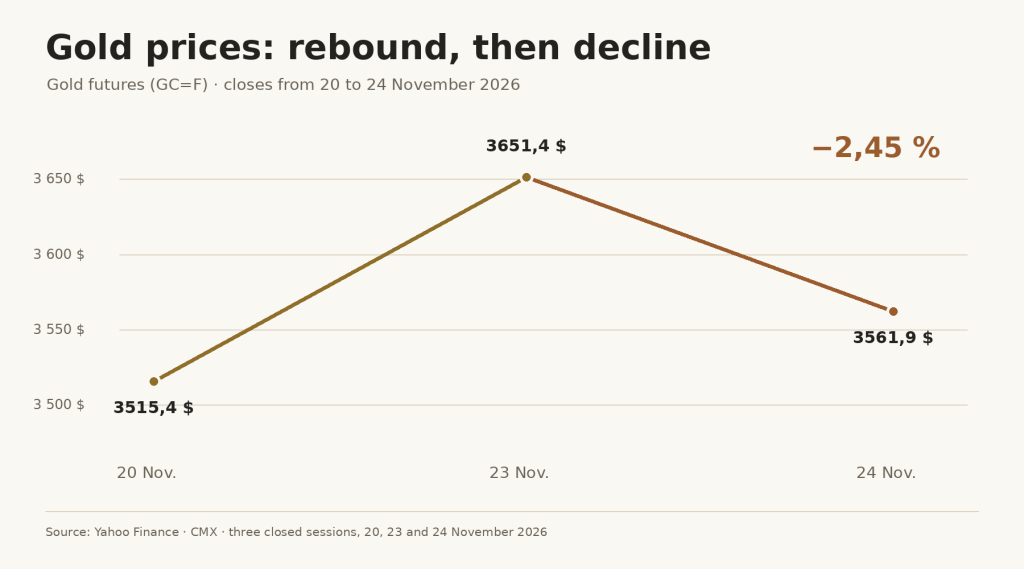
Gold futures (GC=F) closing prices for 20, 23 and 24 November 2026. Source: Yahoo Finance / CMX.
On 24 November 2026, gold fell by about 2% after a marked rebound. Markets were expecting higher US interest rates, while some investors were selling to raise cash. New requirements on futures contracts could amplify such selling. A lower price changes neither the physical metal itself nor the role played by purchases for official reserves.
A non-yielding asset facing higher rates
When interest rates and bond yields rise, new interest-bearing investments denominated in dollars compete more strongly with gold, which pays neither interest nor dividends. This is the opportunity cost: choosing to hold the metal rather than an investment that produces an income has a price.
The market revalues gold by comparing it with the other investments available. The metal contained in a bar remains unchanged, but its attractiveness relative to investments that pay a return is reassessed as interest rates and the dollar move.
Positions under pressure and a need for liquidity
Falls in US equities add another source of pressure. CNBC reports that some investors are closing positions in gold and silver to raise cash. In such circumstances, gold is not necessarily being sold because investors have lost interest in it. It can also be sold because it allows its holder to obtain liquidity quickly.
The CME has also raised the margin required on its gold futures contracts from 5% to 6%, effective after the close on 24 November. This margin is intended to cover the risk associated with a futures position. To maintain that position, its holder must tie up more liquid funds with the intermediary.
This can reduce exposure and add pressure on prices. It does not, however, establish a definite causal link with Tuesday’s fall, which occurred before it took effect. The mechanism described is a financial constraint on positions, not a deterioration in the metal itself.
The different timeframe of reserve buyers
Official reserves are managed according to a different timescale from short-term trading. A sharp 10% move in either direction does not erase a policy of accumulation built up over years. These programmes belong to reserve management, rather than to a bet on the next trading session.
The People’s Bank of China announced in October its 24th consecutive month of gold purchases, according to the World Gold Council. This continuity illustrates the long-term nature of its reserve management. Such purchases can coexist with declines in the price of gold without establishing a floor beneath the market.
What this changes for physical gold holders
A gold bar is not a futures position. Assessing it involves its fine weight, purity and format, as well as costs, resale conditions and the intended holding period. At GSC, these criteria take precedence in the advice that accompanies a valuation of the physical metal.
In short, the price responds to interest rates, the need for cash and constraints on positions. The People’s Bank of China’s reserve programme, meanwhile, runs on a different horizon, whatever the market’s dips and rebounds.