
—
—
*Updated on 26 September 2026*
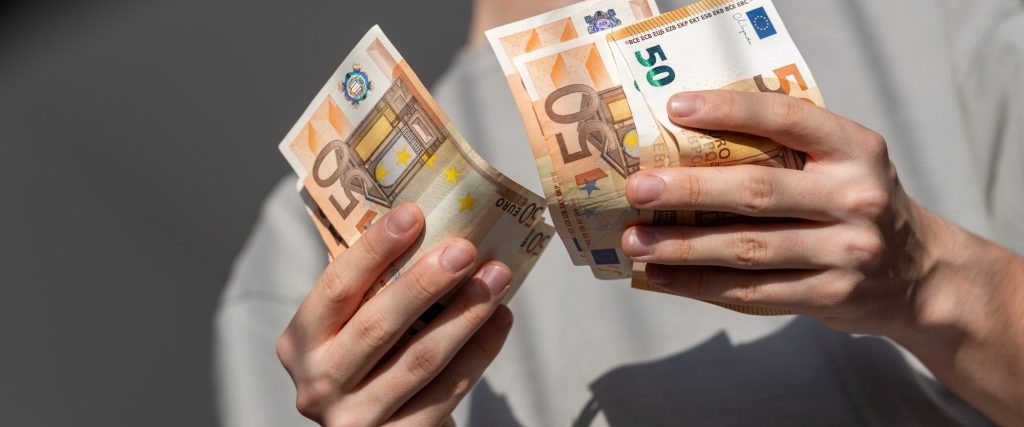
On 23 July 2026, in Frankfurt, Christine Lagarde unveiled on stage the ten shortlisted designs for the future euro banknotes. A polished staging, a finely turned phrase: « Euro banknotes are more than a means of payment; they are one of the most tangible symbols of Europe. » The public consultation, which closed on 21 September, exceeded every expectation: more than six million votes in the very first week. Europe is choosing between Leonardo da Vinci, Maria Callas and the kingfisher.
And every time Europe touches its banknotes, an old Belgian story rises back to the surface. It dates from October 1944, it bears the name of a finance minister, and it illuminates this moment better than any market commentary.
Frankfurt, July 2026: the first complete redesign since 2002
The facts first, as the ECB publishes them. The next series of banknotes will be the first total redesign since they entered circulation. Two themes are competing: « European culture », carried by famous faces, and « Rivers and birds ». More than 1,200 designers entered the contest, a jury of 21 experts appointed by the euro area central banks retained ten proposals, and the Governing Council will decide towards the end of 2026.
The timetable deserves a careful reading. After the decision will come the refinement of the design, the tests, then production: the ECB itself writes that it will take several years before these banknotes reach the hands of the public. And it states, in black and white, that the banknotes of the current series will retain their value and will circulate in parallel with the new series. Nothing in this project creates money or withdraws it: a graphic redesign is not a monetary operation. New security features, better accessibility, a refreshed symbol. That is all, for today.
October 1944: the week Belgian banknotes changed nature
There was, however, a moment in this country’s history when « changing the banknotes » meant something else entirely.
At the Liberation, Belgium was sitting on an unprecedented mass of francs: four years of occupation had swollen the circulation from roughly 50 to some 165 billion francs, while the shop shelves were emptying. Camille Gutt, finance minister of the London government, had prepared the response as early as 1943, in secret: brand new banknotes, printed in England, were waiting in crates before the country was even liberated.
The decree-laws came down on 6 October 1944. From the 9th, denominations of 100 francs and above ceased to be legal tender. Every resident could exchange 2,000 francs, enough to live on for a few weeks. Everything else had to be deposited and declared: part was blocked temporarily then released in instalments, the remainder was blocked definitively, converted into a forced loan and subjected to the special taxes on war profits. Within days, the money supply fell back to around 60 billion. Economic history has retained the « Belgian miracle »: the franc held, the inflation ravaging the neighbours was contained, and the shops were restocked among the first in Europe. Camille Gutt himself would become, in 1946, the first managing director of the International Monetary Fund.
Money, too, has known its Hunt brothers: in 1980, two Texan heirs attempted to own the world silver market before the rulebook was rewritten. The price can lie, the weight never can: the full story of the Hunt brothers’ corner can be read on the dedicated page.
What the Gutt operation teaches, without fear and without prophecy
Let us be precise, because precision is the only honest way to summon history: the redesign announced by the ECB has nothing in common with the Gutt operation. One redraws denominations that keep their value; the other demonetised a country in a single week to extinguish a wartime inflation. No one can seriously compare the two situations, and this article does not.
What 1944 teaches is simpler, and more durable. A banknote is a convention: its value rests on the conditions that an institution writes, and those conditions can be rewritten, for better or for worse, when circumstances require it. The Belgian savers of 1944 did not hold fewer francs on 5 October than on the 10th; it was the very definition of their francs that had changed over the weekend. India replayed a comparable score in 2016 by withdrawing its 500 and 1,000 rupee notes overnight. Each time, the mechanism is the same: when a series dies out, the banknotes must pass back through a counter, and the counter counts.
While the design changes, the quantity keeps growing
Let us be honest for two minutes, and the figures are enough: they come from the ECB itself. A graphic redesign prints nothing, that is understood. But every new series belongs to a longer story, that of a currency whose quantity has never stopped growing. More than thirty billion banknotes circulate today in the euro area, worth more than EUR 1,500 billion, not counting deposit money, incomparably larger, which fifteen years of asset purchase programmes have carried to levels no founding father of the euro would have imagined. Every crisis has had its answer, and every answer has had the same instrument: more money.
There is a simple yardstick for measuring this movement, the oldest of all. At the birth of the euro banknotes, in 2002, an ounce of gold changed hands at around 330 euros. Today it changes hands beyond 3,700 euros. The ounce has not changed: same weight, same fineness, same lustre. What has changed is the quantity of euros one must line up to obtain it, more than eleven times as many in a single generation. One may debate the merits of each monetary policy; one cannot debate this ratio. Metal judges no one: it counts.
That is the second lesson, complementary to the one from 1944. The Gutt operation showed that a banknote can be redefined in a week; the history of the euro shows that it also dilutes without a decree, silently, series after series. In both cases, the wealth-preservation answer is the same: a share of matter, which cannot be rewritten and cannot be printed.
Metal never changes series
There is one category of wealth that the Gutt operation did not touch, and for good reason: it did not need to be exchanged. Physically held gold was worth, on 10 October 1944, exactly what it had been worth on the 5th. Not because a decree had protected it, but because no decree defined it. A bar carries no terms and conditions: a weight, a fineness, a hallmark, and that is all.
From our experience in the field at Gold & Silver Company, this is exactly how our clients formulate their choice: they do not flee money, they use it every day; they simply want part of their wealth to depend on no rewriting. Metal is bought, measured and bought back against a live gold price, it is kept at home or in safe deposit vaults outside the banking circuit, and it is sold back at the agency, weighed in front of its owner, the scales’ display turned towards them. The new ECB banknotes may well be magnificent; the kingfisher has our vote. But the bar, for its part, will still need no design contest.
Frequently asked questions
Will the euro banknotes I hold lose their value with the new series?
No. The ECB states it explicitly: the banknotes of the current series will retain their value and will continue to circulate in parallel with the new ones, just as the first series of 2002 still circulates alongside the Europa series. No demonetisation has been announced, near or far. The wealth question is therefore not « will my banknotes die », but « what share of my wealth do I wish to keep in the form of a promise, and what share in the form of matter ». It is a question of balance, personal to each individual, and our experts discuss it every day at the agency in Dottignies (Mouscron), without an appointment.
Could the story of the Gutt operation happen again today?
The circumstances of 1944 were exceptional: a wartime money supply, a country to rebuild, an inflation ready to sweep everything away. Nothing comparable exists today, and the ECB redesign is a graphic project, not a monetary one. What history does teach, however, is that money is a revisable convention: Belgium in 1944, France in 1945, India in 2016 have each shown it in their own way. That is precisely why many of our clients hold, alongside their accounts, a share of physical metal: not out of distrust, but out of balance.
Has gold ever been affected by a banknote exchange in Belgium?
During the Gutt operation, the freeze targeted banknotes and account balances: gold physically held by private individuals had nothing to exchange and nothing to declare at the monetary counter, since it depended on no legal tender. It is the most concrete illustration of its nature: metal cannot be demonetised. At Gold & Silver Company, this reality is lived at the agency: an old bar, inherited, even without documents, is weighed, tested and bought back at the price of the day, whatever the era of its manufacture. A banknote has a series; a bar has only a fineness and a weight.
Where can I keep gold if I do not want to keep it at home?
The firm opened the first private safe deposit vaults outside the banking circuit in Belgium, in Dottignies (Mouscron): access during opening hours, annual rental, complete discretion, and the contents of the safe deposit box belong to their tenant alone. It is the natural complement of physical metal: a matter that depends on no series of banknotes, kept in a place that depends on no bank counter. The details of the rental plans are on the page dedicated to safe deposit boxes, and the team answers by telephone or by email for any preliminary question.