
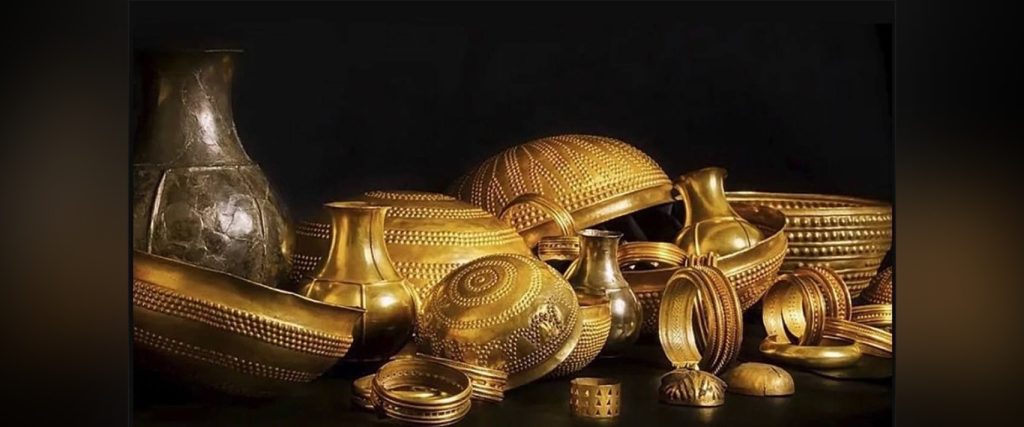
*The Treasure of Villena, a Bronze Age goldwork assemblage. (c) Museo Arqueológico de Villena*
At 5:16 a.m. on August 27, 2026, an alarm sounded in a sports complex on the outskirts of Villena, in the province of Alicante. Security forces headed there. At 5:20 a.m., the alarm of the municipal museum, the MUVI, was triggered. At 5:24 a.m., when officers arrived, the perpetrators had already vanished. In four minutes, a major part of a treasure that had survived nearly three millennia disappeared.
The Treasure of Villena was not a mere accumulation of ancient metal. It brought together bracelets, cups, flasks, silver, amber and even two objects fashioned from iron that came from space. Its weight could be calculated. Its history could never be reproduced. This theft places before Europe’s eyes a reality that contemporary portfolios sometimes forget: long before banks, markets and minted coinage, civilizations had already chosen gold to materialize wealth and pass it on.
*Article finalized on August 28, 2026. As the investigation and the definitive inventory of the missing objects are still under way, some details may be refined as official communications are released.*
A four-minute theft, one month after the Vix torc
The operation began before the museum was even entered. The first alarm, at the sports complex, looks very much like a diversion intended to draw patrols away. The perpetrators first tried the MUVI’s main entrance, fell back on a protected side window, then emptied the display cases. Early communications mention at least three individuals visible on the recordings and two vehicles. The municipality speaks of an « ultra-fast and ultra-professional » operation, even though every security system was activated.
The provisional toll gives the measure of the disaster: virtually all the gold objects were taken. Only the three silver vessels, the meteoritic iron bracelet and part of the fittings of a staff remained on site. Three antique crowns of the Virgin and Child, unrelated to the prehistoric hoard, also disappeared; a fourth was found in a corridor, dropped in the flight. This burglary comes barely a month after the theft of the Vix torc, a Celtic masterpiece of 480 grams of gold stolen in broad daylight at Chatillon-sur-Seine and still unrecovered. The fear of the Spanish authorities is the same as in France: that the pieces will be melted down for the value of the metal alone. The loss would then be irreparable.
What did the Treasure of Villena actually contain?
The 2005 Spanish decree classifying the assemblage as an Asset of Cultural Interest inventories 67 pieces and sets the weight of the gold objects at 9,109.28 grams, at a fineness close to 23.5 carats. Including the gold applied to composite pieces, the precious metal approaches 9.112 kilograms. Insurers have cited roughly 1.7 million euros for the material value alone. The inventory describes 28 bracelets, 11 cups and bowls, two gold flasks, three silver flasks, fragments of gold leaf probably from weapon fittings, one element combining gold and amber, and two objects of meteoritic iron.
To reduce this assemblage to a weight would nonetheless be to miss the essential. The largest of the bracelets weighs nearly 460 grams and bears 522 small conical spikes arranged in regular rows. Some cups exceed half a kilogram. The flasks required assembly techniques far more complex than the bowls. The artisans who produced these pieces around 1000 BCE knew how to select the material, melt it, beat it into sheet, shape it and decorate it. The metal already had weight; the object already had intention. This technical continuity, from the first Bronze Age smelting to contemporary processes, is traced in our page From Babylon to CERN, the history of gold refining.
Meteoritic iron, or when value is not obvious at first glance
Two objects in the Treasure long intrigued researchers: an open bracelet, dark and partially oxidized, and a small semi-spherical form covered with gold leaf. Analysis established that they had been fashioned from nickel-rich iron of meteoritic origin, at a time when the metallurgy of terrestrial iron was not yet mastered in the Iberian Peninsula. This iron fallen from the sky was then rarer than gold itself: it had been judged worthy of resting beside nine kilograms of worked gold.
After the theft, the meteoritic iron bracelet was among the objects left behind. The dark mass clearly failed to catch the eye, while the gilded piece that accompanied it disappeared. It would be imprudent to attribute a line of reasoning to the perpetrators, but the scene sums up two ways of reading an object: immediate appearance made it a dull ring of no interest; scientific analysis made it one of the most singular pieces in Europe. What seems least precious is sometimes what holds the most value. It is a lesson every owner of antique jewellery, coins or inherited objects should keep in mind before selling anything by weight.
1963: a discovery saved by those who knew how to recognize it
The Treasure had already escaped disappearance once before. In 1963, gravel extracted from the Rambla del Panadero was spread across construction sites in Villena. A gold bracelet surfaced among the materials and passed from hand to hand; some took it for a mechanical part. It ended up with the jeweller Carlos Miguel Esquembre Alonso, who understood that the object deserved a different kind of attention and, on October 22, alerted the archaeologist Jose Maria Soler Garcia. A second bracelet emerged on November 25 and made it possible to trace the gravel back to its origin. On December 1, at 5 p.m., a strike of a tool uncovered the large ceramic basin containing the hoard.
The rest belongs to Spanish history: the photographs of the cache, the public presentation at Christmas 1963, then, on December 27, the railway worker Pedro Lorente Garcia, who voluntarily returned a third bracelet that his daughter had recognized in the display cases. The Treasure was not saved by one providential person, but by a chain: workers, a jeweller capable of identifying what he was holding, an archaeologist, a team, a town. Before it became national heritage, it first had to be recognized. From our experience in the field at Gold & Silver Company, we often observe the same thing on another scale: the value sleeping in a drawer only reveals itself the moment a professional knows how to name it.
What three millennia teach a modern estate
The Treasure of Villena predates by several centuries the first minted coinage in the West, which appeared in Lydia toward the end of the seventh century BCE. Its owners knew neither price fixings, nor securities accounts, nor central banks. Yet they had identified what still makes gold singular: value concentrated in a small volume, absolute resistance to corrosion, a material that is divisible and remeltable without losing its nature. The civilization that buried these pieces vanished along with its roads, its authorities and even the name of their owner. The material was still there.
A modern estate rests largely on promises: a share represents an equity interest, a bond a claim, a bank deposit a sum owed by an institution. These assets are indispensable to the economy; they finance, yield returns and circulate. But physical gold held directly belongs to another category: it needs the promise of no issuer to exist. Its price fluctuates, its custody must be organized, its ownership documented; its reality depends on no one. The estate question is therefore not to choose between matter and modernity, but to balance what is held against what is owed. We develop this framework in Gold and purchasing power and in our Gold Guide.
The price by weight is never the price of history
1.7 million euros of metal; a heritage value no one can quantify. These two figures do not measure the same thing, and that is precisely the heart of our profession. At Gold & Silver Company, every object is first read before it is weighed: an antique coin is a currency, a type, a vintage before it is a weight of fine gold; a Napoleon carries a premium and a monetary history that the scale ignores; a signed jewel can be worth several times its metal content. Our page Jewellery and diamonds details this prior qualification, which protects our clients from the worst mistake in the market: selling history at the price of weight.
Only once the object is understood does the integrated Smelter-Refinery come into play, if transformation is the right destination. Assay, melting, refining: the material then receives a new heritage form, traceable and certified in-house, in a short European circuit. A house that masters its material does not look at everything as mere material: preserving an object and transforming a metal are two different destinations, which demand the same first gesture, understanding exactly what is presented. Three thousand years of history have not made gold an ancient product. They have made it a material that is always contemporary, one that our page What happens to your gold after you sell it? follows to the very end of its cycle.
Frequently asked questions about the Treasure of Villena and the value of antique gold
How can I tell whether my antique jewellery or coins are worth more than their weight in gold?
That is exactly the lesson of the meteoritic iron bracelet of Villena: appearance does not tell value. A coin can carry a numismatic premium linked to its type, its year or its mint; a jewel can be worth far more through its signature, its period or its stones than through its metal. The only reliable method is a two-stage appraisal, the object first, the material second. At Gold & Silver Company, this dual reading is systematic and free of charge at our agency in Dottignies: bring your coins, jewellery or inherited objects, and leave with a clear assessment of what deserves to be kept, sold as an object or transformed. Our page Jewellery and diamonds explains the approach in detail.
If I sell my gold, is it melted down immediately?
No, and that is an essential difference from buyers who ship everything by weight to anonymous smelters. At Gold & Silver Company, every lot is first qualified: a sought-after coin or a signed jewel never goes to the melt without that additional value having been paid to you. Only metal for which transformation is the right destination joins our integrated Smelter-Refinery, where it is assayed, melted and refined on site, in a short European circuit, with no intermediary. This in-house mastery allows us to pay the fair price, at the day’s rate, publicly displayed. The full journey is described in What happens to your gold after you sell it? and on our Refinery page.
Is physical gold safer than a financial investment?
It is above all of a different nature, and that is what three millennia demonstrate. A financial investment is a promise: equity interest, claim or deposit, it depends on an issuer and on institutions to exist. Physical gold held directly depends on no one: its price fluctuates, but its reality rests on no third party’s commitment. A balanced estate does not oppose these two worlds, it articulates them: productive assets for yield, a share of matter for permanence. In our experience, our Belgian and French clients use physical gold as a long-term foundation, not as a short-term bet. To build that share with peace of mind, start with our Gold Guide or come and talk it over at the agency.
How can I protect my gold against theft?
The Villena theft is a reminder that no display case is inviolable, and a home is even less so: the bulk of the gold stolen every year comes from private residences. The right practice is simple: keep at home only what you accept losing, and place the rest in a dedicated vault facility, outside the banking circuit, insured and accessible without notice. Gold & Silver Company makes secure safe deposit boxes available to its clients in Dottignies, in one of Belgium’s first private vault facilities, with total discretion and access free of any banking dependency. Your gold remains your direct property, physically identified, and you can visit it whenever you wish.
Where should I start building an estate in physical gold?
Start with liquid, recognized vehicles that are easy to resell: listed investment coins such as the 20-franc Napoleon, the Sovereign or the Maple Leaf, and certified bars from one gram to one kilo. Our French clients predominantly choose the Napoleon, liquid on both sides of the border; our Belgian clients readily blend coins and bars. What matters is buying at the real rate, publicly displayed, from a house that masters its material: our status as an approved smelter allows us to quote both when buying and when selling, with no intermediary. Come to the agency in Dottignies or browse our investment coins to define the first step of your estate. *Updated on August 28, 2026.*