
# Why Europe comes to Belgium to sell its gold
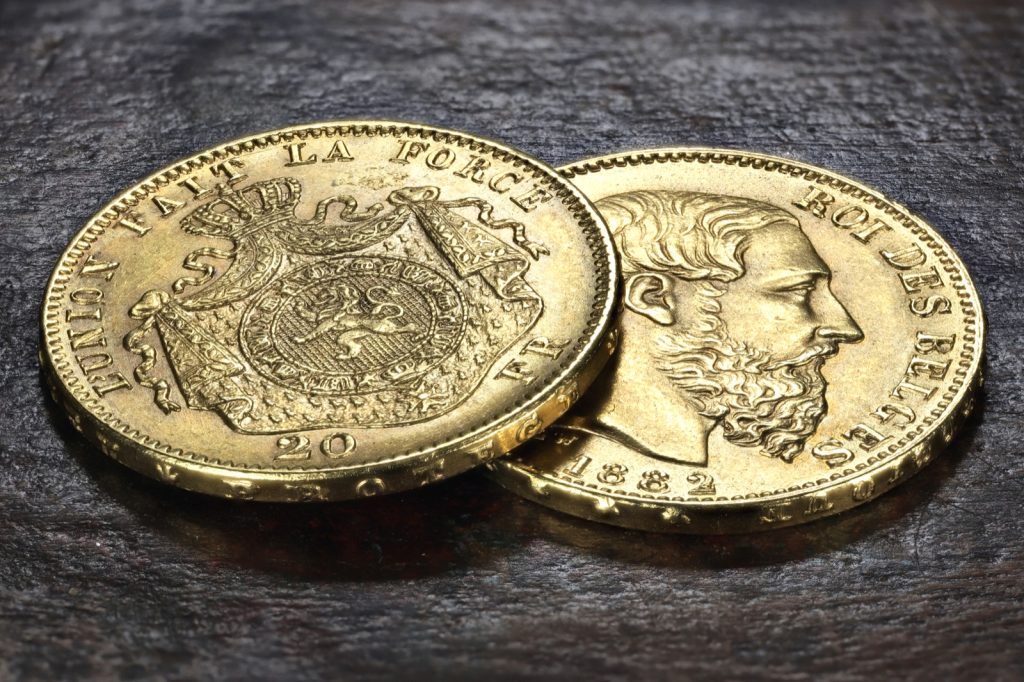
Few countries have engraved their motto in gold. Belgium has. From 1867 to 1882, every 20 franc coin struck in the image of Leopold II bore on its reverse the coat of arms of the kingdom and its motto: L’union fait la force. And that coin did not stay within the borders of the young kingdom: it settled business in Paris, in Milan, in Geneva, accepted everywhere on strictly equal terms with the local currencies. A national motto travelling from hand to hand across Europe, carried by 5.806 grams of fine gold: that is how a country announces what it knows how to do.
At Gold & Silver Company (GSC), an integrated foundry and refinery, open to private individuals and professionals, based in Dottignies (Mouscron), we hold this history for what it is: not a backdrop, an explanation. If sellers cross the border today to entrust their gold to Belgium, it is not an accident of geography. It is the logical continuation of a country that has mastered metal for centuries and has made it a complete profession.
Expertise older than the country itself
Long before Belgium, there was Belgian metal. In the Middle Ages, the copper beaters of the Meuse valley, in Dinant, Huy, Namur and Liege, carried their art so high that all of Europe ended up giving their city as a common noun to an entire craft: dinanderie. When a know-how becomes a word in the language, it is because the country embodied it better than all the others. Fire, alloy, fineness, striking: this grammar of metal has been learned here for eight centuries.
The rest of the story confirms the vocation. Belgium has counted for centuries among the great European diamond centres, and its ports today house the largest precious metal recycling sites in the world. The National Bank of Belgium holds 227 tonnes of gold, documented and publicly debated in Parliament. A country of thirty thousand square kilometres carrying this weight in the world’s precious metal does not improvise itself: it is inherited, passed on and maintained.
1865: Belgium co-founds Europe’s first monetary union
On 23 December 1865, France, Belgium, Italy and Switzerland signed the Latin Union convention in Paris, joined by Greece in 1868. The principle fits in one sentence: each country strikes its own coins in its own image, but all respect the same specification, inherited from the franc germinal of 1803. For the 20 franc gold coin: 6.45161 grams at 900 thousandths, or 5.806 grams of fine gold, whether it is Belgian, French, Italian or Swiss.
A century and a half before the euro, monetary Europe therefore already existed, and Belgium sat at the founders’ table. The Belgian 20 francs was not a cousin of the French Napoleon: it was its strict equal, gram for gram, accepted without arbitration from one end of the continent to the other. Metal professionals moreover call it the Louis belge, after its French equivalent. The motto engraved on the reverse told the truth: it is indeed the union, that of weights, finenesses and strikings, that made the strength of these currencies.
A country where selling gold is a complete profession
This heritage is not a museum. It has become an industry, the densest in Europe: dealers, diamond merchants, gemmologists, assayers, founders, refiners and numismatists work here within a few tens of thousands of square kilometres. For anyone who owns gold, this density changes the very nature of the undertaking: in Belgium, one does not merely compare shop signs, one compares professions. A broker sells a price. A refinery masters the material.
This is precisely what attracts sellers from all over Europe: elsewhere, the person selling gold almost always meets an intermediary; here, they can meet directly those who analyse, melt and refine the metal. We have devoted complete guides to this Belgian singularity: the expertise of jewellery and diamonds, and the method for comparing gold buying offers.
What passes through our expertise rooms
From our field experience at Gold & Silver Company, the border no longer stops anyone. Estate jewellery cases arrive from Marseille, from Barcelona, from Paris, from Lille as well as from Brussels, and the Latin Union reassembles itself on our workbenches: French Napoleons mixed with Belgian 20 francs, with Swiss Vrenelis, sometimes with a Greek coin left there by a travelling ancestor. One hundred and sixty years after the convention was signed, these coins find themselves side by side, exactly as their signatories intended. This converging Europe is the entire subject of our guide selling gold in Belgium.
The most frequent mistake we observe: lots sold elsewhere by weight, in bulk, without anyone having checked the dates. With us, every coin deserves its examination and every line of the quotation is detailed, coin by coin, with the screen of the metrology scale turned towards the client. GSC is the only player with a fully integrated model, open to both private individuals and professionals directly, without brokerage fees, without tax withheld at source. An independent neo-foundry, approved by the Royal Mint of Belgium, under the supervision of an approved assayer, the house analyses, melts, refines, controls and manufactures under one roof. The announced price is the amount paid. And before selling a lot anywhere at all, our article how to choose who to sell your gold to provides the benchmarks for comparing offers.
Come and sell your gold where metal is at home
The motto must be taken seriously, because it describes exactly what awaits you. L’union fait la force is the union of professions under one roof rather than a chain of intermediaries reselling your metal to one another, each taking their margin. It is the union of an entire national industry, from the Belgian ports to the expertise rooms, in the service of a single thing: the fair price of the material. It is finally the union of a country and its metal, eight centuries of continuity between the copper beaters of the Meuse and the metrology scales of our laboratory.
So the question is no longer whether you should sell your gold in Belgium. It is what you lose every time you sell it anywhere other than Belgium. The Leopold II 20 francs, for its part, has already answered: since 1867, it has been crossing borders to go where metal is understood. The currencies that replaced it have disappeared, the regimes that struck it too, and its 5.806 grams of fine gold are still there. Physical gold does not promise. It exists.
Frequently asked questions about gold
What does the motto L’union fait la force mean on Belgian gold coins?
It has been the national motto of Belgium since the country’s independence. It appears on the coat of arms of the kingdom and on the reverse of its gold coins, including the 20 francs Leopold II struck from 1867 to 1882. On a Latin Union coin, it takes on an additional meaning: it was the union of European monetary specifications, the shared weight, fineness and striking standards, that made the strength of these coins, accepted from one country to another without conversion, without discount and without negotiation. A motto engraved in gold is a commitment: these coins kept it from Paris to Geneva for more than half a century, and it is this reliability, proven over time, that still underpins their value today.
What was the Latin Union and why does it still matter today?
It is the monetary convention signed in Paris on 23 December 1865 by France, Belgium, Italy and Switzerland, joined by Greece in 1868: distinct national currencies, but a common specification of 6.45161 grams at 900 thousandths for the 20 franc gold coins. It still matters because millions of these coins still exist in family estates across Europe, and their value rests precisely on that standard: 5.806 grams of fine gold per coin, regardless of the country of striking. When such a coin is presented for sale today, that shared specification makes it immediately readable, comparable and tradable: any serious professional, in Brussels as in Paris or Milan, knows exactly what it weighs and what it contains.
Is the Belgian 20 franc gold coin worth as much as the French Napoleon?
Their fine gold content is strictly identical: 5.806 grams. The base value is therefore the same, to the nearest gram. The premium on the Belgian 20 francs generally remains more discreet than that of the Napoleon, whose fame sustains demand, and certain dates or exceptional states of preservation can clearly exceed the value of the metal itself. This is precisely what a coin by coin examination makes it possible to settle before any decision: weight, fineness, year, mint and condition are assessed separately, line by line, so that the seller knows exactly what they own and what each coin is truly worth on the market at the moment of sale.
Sarah, Managing Director, Gold & Silver Company
*Article written and maintained by Gold & Silver Company, Belgian neo-foundry of precious metals. Updated on August 2026.*