
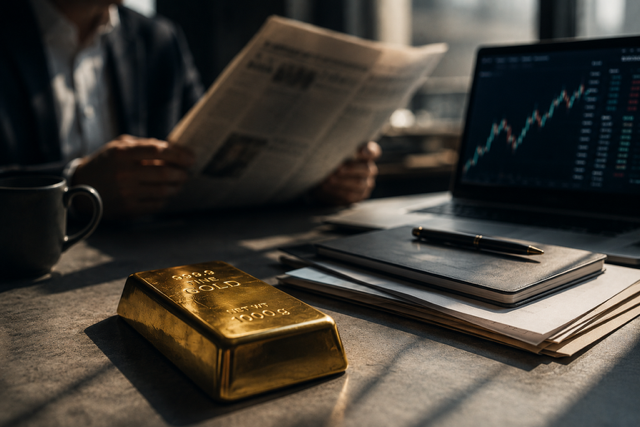
# Paper gold: the gold price you see may not be the metal’s real price
The « gold price » you see scrolling everywhere is, in reality, nobody’s price
This Monday, 29 June 2026, the ounce of gold is trading around 4,050 dollars, or nearly 114 euros per gram of fine gold. That figure is displayed everywhere, right down to your trading app. And yet, at that exact price, you can neither buy nor resell a single gram of metal. Nobody will put it to you so bluntly: so let us say it here.
Between the price on display and the price of the metal you hold in your hand, a gap opens up. And that gap, today, keeps widening.
The price you see belongs to fifteen banks alone
The famous gold price has nothing magical or universal about it. It is set twice a day, at 10:30 a.m. and 3:00 p.m. London time, in an electronic auction administered by ICE Benchmark Administration, in which fifteen member banks of the London Bullion Market Association take part. This wholesale price, negotiated between professionals for tonnes of metal, serves as the reference for almost every gold product on the planet. It is an insiders’ price: the private individual never trades at it.
Two prices, one single gap
On the ground, the moment you want to buy physical gold, every product has two prices. A price at which it is sold to you, always above the spot price: that is the premium. A price at which it is bought back from you, always below: that is the discount. The difference bears a name the industry prefers to whisper: the spread. Nothing scandalous in itself: authenticating, storing, insuring, carrying the price risk, all of this has a legitimate cost. The problem is when it is hidden from you.
Paper, almost never metal
But that counter spread is only the visible gap. There is another, far more dizzying one: the gap between the price of paper and the price of metal. For the price you follow is not born of gold bars moving from one vault to another. It is born of contracts. Every day, nearly 20 million ounces change hands in London, with barely a gram moving: in five or six sessions, paper churns through an entire year of world mine production. Silver knows the same vertigo. The price is therefore formed on promises, not on weight. And those promises have been rigged before: in 2020, JPMorgan was fined a record 920 million dollars, and two of its precious metals heads were sentenced to prison for distorting prices for years. There is nothing sacred about the « official » price.
The East and the real are taking back control
While the West keeps its contract printing press turning, the East counts in kilos. Since 2016, the Shanghai Gold Exchange has set its own benchmark price, in yuan, based on physical bars actually delivered into its vaults: no promises, just metal. When Shanghai pays more than London, Asian physical demand no longer recognises itself in the price manufactured in the West. Central banks, for their part, have bought more than 1,000 tonnes of gold a year for three years running, and they demand delivery. And when the real tightens, paper cracks: in early 2025, hundreds of tonnes left London for New York, and the wait to withdraw one’s metal from the Bank of England stretched from a few days to four, even eight weeks. The market that promises delivery in two to three days did not keep its word.
Tomorrow, a price set by those who hold the metal
This is where the story leads: the real price is no longer decided in a London auction room, but wherever metal changes hands. It is the physical players, the Gold Brokers of the entire world, from Belgium to Singapore, who create liquidity; it is they who decide which gold coins and which gold bars are sold, bought, and at what price. Paper sets an index; the field sets the real. From there, one question imposes itself: why leave this price to fifteen banks? The physical players could build their own: an association, a worldwide conglomerate of dealers, a standard backed by deliveries rather than promises, a genuine counterweight to the LBMA. The idea borders on utopia: it would demand a trust and a discipline that this market, shattered into a thousand counters, has never known. But the metal is already flowing east, and the paper is cracking.
The paper price belongs to fifteen banks. The metal already belongs to those who hold it.
Sarah, Managing Director
Frequently asked questions about gold
Why can I never buy gold at the spot price shown on my screen?
Because the spot price of gold is a wholesale price, fixed twice a day in London by fifteen member banks of the London Bullion Market Association, for transactions involving tonnes of metal between professionals. No private individual trades at that level. When you buy a bar or a coin, you pay the spot price plus a premium that covers the manufacturing, certification, transport, storage, insurance and distribution of the physical product. When you sell, you receive the spot price minus a discount. The difference between the two is the spread, and it is the true cost of transforming a screen quotation into metal you can actually hold. A professional who quotes you the spot price without ever mentioning the premium is showing you a price that does not exist for you.
What exactly is the premium on a gold bar or a gold coin?
The premium is the difference, always positive, between the spot price of the metal and the price at which a physical product is sold to you. On certified gold bars, it reflects the cost of refining, assaying, numbering and sealing the bar, plus the intermediary margins. On investment coins, it also incorporates the minting work and the collectability of the piece, which is why two coins of identical weight can carry different premiums. The premium is not a hidden fee: it is the price of physical existence, of authenticity and of immediate availability. It widens when demand for metal surges faster than the industry can strike and deliver products, and it narrows in calm markets. Comparing premiums, rather than spot prices, is how you compare sellers.
What is the difference between paper gold and physical gold?
Paper gold is a contract: a futures position, a certificate, an exchange-traded product, a promise of metal that almost never ends in a delivery. Physical gold is the bar or the coin you hold in your hand. The gold guide published by Gold & Silver Company details this distinction, which the spot price alone conceals. Every day, nearly 20 million ounces of paper gold change hands in London, while barely a gram of metal moves; in five or six sessions, the paper market churns through an entire year of world mine production. The price you follow is therefore formed on promises, not on weight. When holders of paper simultaneously demand delivery, as happened in early 2025, the system slows down and withdrawal delays stretch from days to weeks.
Who actually sets the gold price, and how?
The reference price is set twice a day, at 10:30 a.m. and 3:00 p.m. London time, through an electronic auction administered by ICE Benchmark Administration, in which fifteen member banks of the London Bullion Market Association participate. Since 2016, the Shanghai Gold Exchange has set its own benchmark, in yuan, based on physical bars genuinely delivered into its vaults. Neither of these prices is the price of your bar or your coin: they are wholesale references between professionals, from which every physical product diverges through its premium and its discount. Understanding this mechanism is the first step before any purchase, because the price that concerns you is the one at which a counter actually sells to you and buys back from you, not the one scrolling across a screen.
How do I know the real price of the metal I am buying or selling?
The real price is the one at which a professional physically commits, in writing and before your eyes: spot price plus the premium when you buy, spot price minus the discount when you sell. Ask for both figures, and ask what they contain. At Gold & Silver Company, the calculation is broken down line by line at the counter, indexed to the live market price, so that the multiplication can be redone by the client. If you are unsure of the value of a bar, a coin or a jewel, the simplest step is to book an appointment at the agency in Dottignies: the metal is tested and weighed in front of you on a certified scale, and the price is explained before any commitment. A price you cannot verify is a price you should not accept.
*Updated on 26 September 2026.*