
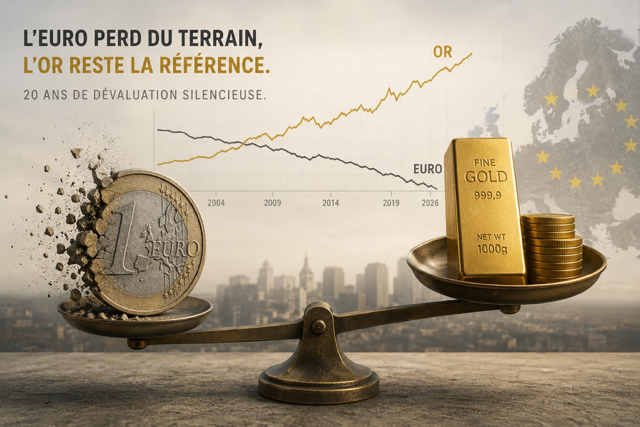
# The euro, twenty years of silent devaluation
In 2004, one euro bought a coffee, a newspaper and a croissant. Today, it barely covers the coffee alone.
This is not an anecdote: it is the summary of twenty years of monetary erosion, measured, documented, and largely ignored.
Since its creation in 1999, the euro has lost 85% of its value against gold. This figure, published by GoldBroker and confirmed by World Gold Council data, should appear on the front page of every bank statement. It does not. And that is precisely the problem.
Savings held in euros melt away; the ounce of gold, for its part, travels through time.
Why the euro has been losing value for 20 years
According to ECB and Eurostat data, cumulative inflation in the eurozone since 2004 exceeds 61%. In concrete terms, 100 euros from 2004 are equivalent to roughly 161 euros today: it now takes 161 euros to buy what cost 100 twenty years ago. In other words, every euro in your pocket now buys only 62% of what it bought in 2004. And this calculation still rests on the official consumer price index (HICP), which structurally underestimates the inflation actually felt: housing, energy and food weigh far more heavily in real household budgets than in the index.
This phenomenon is not immediately visible on a bank statement. It is felt at the supermarket, at the petrol pump, when buying a home. While wages rose slowly, the costs of housing, energy and food soared across Europe. This is silent inflation, the kind that eats away at savings without making a sound.
In April 2026, annual inflation in the eurozone reached 3.0%, driven by energy (+10.9%) and services (+3.0%). The ECB’s 2% target remains a pious hope rather than a mastered reality.
How gold protects against inflation in the eurozone
In 2004, the gold price stood at around 330 euros per ounce. By 2014, it had already tripled to roughly 950 euros. In 2020, it crossed 1,550 euros. Today, in May 2026, the ounce of gold trades above 4,200 euros. That is a rise of more than 1,170% in twenty-two years.
Put differently: in 1999, it took 0.13 gram of gold to buy one euro. Today, it takes only 0.02 gram. The euro has not simply declined against gold: it has collapsed. This devaluation is not visible on your bank account, because the figures displayed remain the same. But the real purchasing power behind those figures has melted away.
Concretely, a family that placed its savings in a passbook account in 2004 has seen its purchasing power shrink year after year, without anything changing on its statement. Monetary illusion is at work: the figures remain, the value evaporates.
Protecting your savings from inflation: what the ECB failed to do
The European Central Bank held rates in negative territory for nearly a decade (2014-2022), injected trillions through quantitative easing, and bought sovereign debt on a massive scale. These policies had a direct effect: inflating the money supply, propping up financial markets and real estate, while diluting the value of every euro held by savers.
The bank passbook that yielded 3% in 2004 offers barely 1% today, well below inflation.
The result: whoever left 50,000 euros in a standard savings account in 2004 now holds capital whose real purchasing power is equivalent to roughly 31,000 euros of that time. Whoever converted the same sum into gold bars today holds the equivalent of more than 580,000 euros.
Should you buy physical gold in 2026?
Gold generates no dividends, pays no interest, and promises nothing. But it does something no central bank can guarantee: it preserves value over time. When fiat currencies depreciate under the effect of expansionary monetary policies, the ounce of gold absorbs that devaluation and reflects it in its price.
For European savers, buying gold, whether gold coins, gold bars or physical silver, is not speculation. It is an act of wealth preservation. In precious metals in Belgium and across Europe, physical demand keeps growing, carried by individuals who have understood that time works against currencies and in favour of metal.
Preserving your wealth: what the next twenty years could hold
With European public debt at record highs, chronic budget deficits, and an ECB caught between the need to contain inflation and the need not to suffocate weakened economies, the trajectory of the euro leaves little room for optimism. The same causes produce the same effects: money creation will continue to dilute the value of the currency, while gold, whose supply is physically limited, will continue to reflect that erosion.
The question is no longer whether the euro will keep losing value, but at what pace.
In a permanently shifting monetary environment, understanding the role of precious metals is no longer a speculative exercise, but a long-term wealth consideration. It is a question every European saver should ask, before the answer becomes obvious to everyone. Our gold guide covers these fundamentals in detail.
At Gold & Silver Company, we track these dynamics in real time to offer you the best buying and selling conditions, with full transparency on prices and a technical expertise that few players in Europe can match. If you would like to understand how to position precious metals within your wealth strategy, our teams are available for a no-obligation conversation, at the agency or through an appointment.
Sarah, Gold Broker & Wealth Manager
*Updated on 26 September 2026.*
Frequently asked questions about gold
How much value has the euro really lost against gold since 1999?
Since its creation in 1999, the euro has lost 85% of its value against gold, a figure published by GoldBroker and confirmed by World Gold Council data. Put differently: in 1999, it took 0.13 gram of gold to buy one euro; today, it takes only 0.02 gram. Over the same period, cumulative inflation in the eurozone has exceeded 61% according to ECB and Eurostat data, meaning that 100 euros from 2004 are now equivalent to roughly 161 euros. The gold price, which moved from around 330 euros per ounce in 2004 to above 4,200 euros in May 2026, simply reflects this erosion. Gold does not rise: it is the currency that falls, and the ounce measures that fall with a precision no bank statement will ever display.
Why doesn’t my bank statement show the loss of purchasing power?
Because a bank statement displays nominal figures, not real value. The digits remain identical while the purchasing power behind them melts away: this is exactly what economists call monetary illusion. A saver who left 50,000 euros in a standard account in 2004 still reads 50,000 euros, or slightly more with interest, yet the real purchasing power of that capital now equals roughly 31,000 euros of that time. The loss is not visible at the bank; it is felt at the supermarket, at the petrol pump and when buying a home. Measuring your wealth in ounces of gold rather than in euros is a simple exercise that reveals, year after year, what official figures leave in the shadows.
What did the ECB do that accelerated the devaluation of the euro?
The European Central Bank held rates in negative territory for nearly a decade, from 2014 to 2022, injected trillions of euros through quantitative easing, and bought sovereign debt on a massive scale. These policies inflated the money supply, propped up financial markets and real estate, and diluted the value of every euro held by savers. The bank passbook that yielded 3% in 2004 offers barely 1% today, well below inflation. In April 2026, annual inflation in the eurozone still reached 3.0%, driven by energy at +10.9%, while the official 2% target remains a pious hope. Each wave of money creation mechanically dilutes the currency, and gold, whose supply is physically limited, reflects that dilution in its price.
Is buying physical gold in 2026 speculation or wealth protection?
It is an act of wealth preservation, not speculation. Gold generates no dividends, pays no interest and promises nothing: it simply preserves value over time, which no central bank can guarantee. When fiat currencies depreciate under expansionary monetary policies, the ounce of gold absorbs that devaluation and reflects it in its price. Whoever converted 50,000 euros into gold bars in 2004 today holds the equivalent of more than 580,000 euros, while the same sum left in a savings account has lost nearly 40% of its real purchasing power. Across Belgium and Europe, physical demand keeps growing, carried by savers who have understood that time works against currencies and in favour of physical metal.
Which gold formats should you choose to protect your savings?
For European savers, the choice of format depends on the objective. Gold coins offer flexibility and divisibility, gold bars offer a lower premium per gram as the format grows, and physical silver provides an accessible entry point. What matters above all is traceability: choosing certified gold bars, delivered with their certificate and a compliant purchase invoice, guarantees their acceptance on the international market and their liquidity at resale. A coherent allocation often combines several formats, to balance transmission, liquidity and long-term protection of capital. A professional advisor can help you compose that mix according to your situation, your horizon and the share of your wealth you wish to shelter from monetary erosion.
Where can you buy physical gold safely in Belgium?
Physical gold should be bought from an established professional who verifies the metal, issues a certificate and provides a compliant purchase invoice for every transaction. Gold & Silver Company, a refinery and precious metals dealer based in Dottignies-Mouscron, welcomes savers at the agency for personalised guidance: choosing formats, understanding the day’s price, structuring a progressive purchase. The team tracks monetary dynamics in real time and applies full transparency on prices, with a technical expertise few European players can match. You can prepare your visit with our gold guide, then book an appointment at the agency for a no-obligation conversation about positioning precious metals within your wealth strategy, at your own pace.