
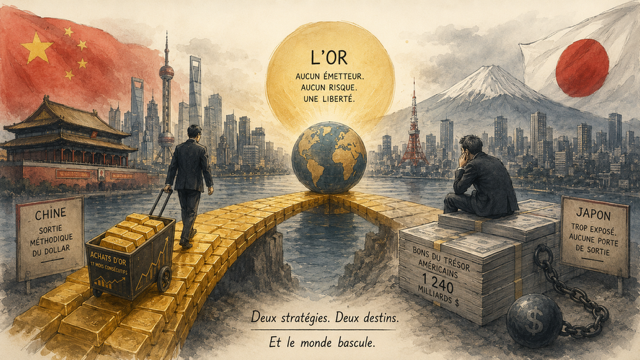
# China is selling its dollars, Japan cannot: the shift to gold has begun
China, Japan and the dollar: why gold is becoming the strategic asset of central banks
Two Asian giants. Two strategies facing the dollar. Only one winner.
In February 2022, the United States froze Russia’s dollar reserves. That day, the whole world understood something simple: your dollars are your dollars only as long as Washington agrees. Since then, two diametrically opposed reactions have taken shape in Asia. And they tell us everything about the future of gold.
Beijing: the great exit, methodical and silent
The figures are brutal. Since 2022, China has liquidated 623 billion dollars of US government bonds. Its Treasury holdings have fallen to 700 billion, their lowest level since 2008. In parallel, the People’s Bank of China has been accumulating gold without interruption: 17 consecutive months of purchases at the latest count. Reserves now stand at 2,313 tonnes, against 1,842 ten years ago.
And that is only what Beijing declares. One figure circulates among analysts: 57% of central bank gold purchases in 2025 were not reported to the IMF. Guess who suspect number one is.
The strategy is crystal clear: exit the dollar without triggering panic, and replace claims on a third country with an asset no one can freeze. Gold depends on no issuer, no government, no server. That is its strength.
Tokyo: 1,240 billion dollars… and no way out
Japan finds itself in the opposite situation. The world’s largest foreign holder of American debt, with 1,240 billion dollars in Treasury bonds, it is trapped by its own exposure. Selling massively would crash bond prices, and therefore the value of what it still holds. The classic trap: too big to exit.
The result? Tokyo bides its time. The Ministry of Finance recently admitted being « ready to stabilise the yen, including by selling US bonds ». The words are carefully chosen. Not « we are selling », but « we are ready to ». A nuance. Meanwhile, the Bank of Japan is suspected of intervening on the foreign exchange market to support the yen, triggering on Friday a collapse of the dollar and a surge in silver to 74 dollars an ounce.
Japan watches the ship sink but cannot jump without sinking with it. China has already jumped, and it climbed aboard a lifeboat made of gold.
What this means for the gold price
Two readings. The first is mechanical: 850 tonnes of official purchases are expected in 2026, according to the World Gold Council, and probably more in reality. This structural demand sets a floor under prices. Even when the ounce corrects by 3%, it bounces back. Central banks are buying the dip.
The second reading is political. If Japan ends up switching, if it starts swapping its US bonds for gold, even at the margin, the signal sent to markets would be seismic. America’s most loyal financial ally dropping the dollar for metal? On that day, the gold price will not rise by 5%. It will change regime.
And in Europe, what are we doing?
We watch. And more and more European savers are drawing the same conclusions as Beijing, at their own scale. You do not need to be a central bank to understand that holding a physical asset, outside the system, with no counterparty risk, is the very definition of prudence. A 20-gram certified gold bar costs 2,655 euros today. No one can freeze it, devalue it or sanction it. That is exactly what China understood before everyone else.
At Gold & Silver Company, we track these dynamics in real time to offer you the best buying and selling conditions, with full transparency on prices and a technical expertise that few players in Europe can match. If you would like to understand how to position precious metals within your wealth strategy, our teams are available for a no-obligation conversation, at the agency or through an appointment.
Anaïs, Gold Broker & Wealth Manager
*Updated on 27 September 2026.*
Frequently asked questions about gold
Why is China selling its US Treasury bonds?
China is reducing its exposure to the dollar for a reason that dates back to February 2022, when the United States froze Russia’s dollar reserves. That decision demonstrated that dollar assets remain yours only as long as Washington agrees. Since then, Beijing has liquidated 623 billion dollars of US government bonds, bringing its Treasury holdings down to 700 billion, their lowest level since 2008. The strategy is methodical: exit the greenback without triggering panic, and replace claims on a third country with an asset no one can freeze, devalue or sanction. Gold depends on no issuer, no government and no server, which is precisely why the People’s Bank of China has been accumulating it for 17 consecutive months, in silence and without interruption.
Why can’t Japan sell its US bonds the way China does?
Japan is the world’s largest foreign holder of American debt, with 1,240 billion dollars in Treasury bonds, and that position has become a trap. Selling massively would crash bond prices and destroy the value of what Tokyo still holds: the classic dilemma of an investor too big to exit. The Ministry of Finance has admitted being « ready to stabilise the yen, including by selling US bonds », but the wording matters: « ready to » is not « selling ». Meanwhile, the Bank of Japan is suspected of intervening on the currency market to support the yen. Japan watches the ship take on water but cannot jump without sinking with it, while China has already climbed into a lifeboat made of gold.
What did the freezing of Russia’s dollar reserves change for central banks?
In February 2022, the United States froze Russia’s dollar reserves, and that day every central bank in the world understood a simple truth: dollar holdings are safe only as long as Washington agrees. A reserve asset that a third country can switch off is not a reserve, it is a dependency. Since then, official gold purchases have accelerated sharply, with 850 tonnes expected in 2026 according to the World Gold Council, and probably more in reality, since an estimated 57% of central bank purchases in 2025 were never reported to the IMF. This structural, price-insensitive demand sets a floor under the gold price and explains why every correction of the ounce is quickly bought back by official buyers.
How much gold does China really hold?
Officially, the People’s Bank of China declares 2,313 tonnes of gold, against 1,842 tonnes ten years ago, after 17 consecutive months of purchases. But « officially » is the operative word. Analysts estimate that 57% of central bank gold purchases in 2025 were not declared to the IMF, and Beijing is widely considered the prime suspect behind these unreported flows. China’s real reserves may therefore be significantly higher than the published figures. What matters for markets is the direction rather than the exact tonnage: the world’s second largest economy is methodically converting claims on the United States into physical metal, an asset outside the system, with no counterparty risk, that no sanction can reach and no government can print.
What would happen to the gold price if Japan started selling its US bonds?
The signal would be seismic. Japan is America’s most loyal financial ally and the largest foreign creditor of the United States. If Tokyo began swapping even a marginal share of its 1,240 billion dollars in Treasuries for gold, markets would read it as the end of an era: the moment when holding American debt stops being the default choice of Washington’s closest partners. On that day, the gold price would not simply rise by 5%: it would change regime, because the last major buyer of US debt would have signalled that physical metal now outranks the dollar. Central banks are already buying every dip; a Japanese pivot would turn that floor into a launchpad.
How can a European saver apply the same strategy as central banks?
The reasoning of Beijing applies at every scale. Holding a physical asset, outside the banking system, with no counterparty risk, is the very definition of prudence, and you do not need to be a central bank to understand it. A 20-gram certified gold bar costs around 2,655 euros today: no one can freeze it, devalue it or sanction it, and it protects your purchasing power over the long term, exactly what China understood before everyone else. Gold & Silver Company, a refinery and precious metals dealer in Dottignies-Mouscron, guides savers through format choice, live pricing and progressive purchases. Our gold guide covers the fundamentals, and you can book an appointment at the agency for a no-obligation conversation with an advisor.