
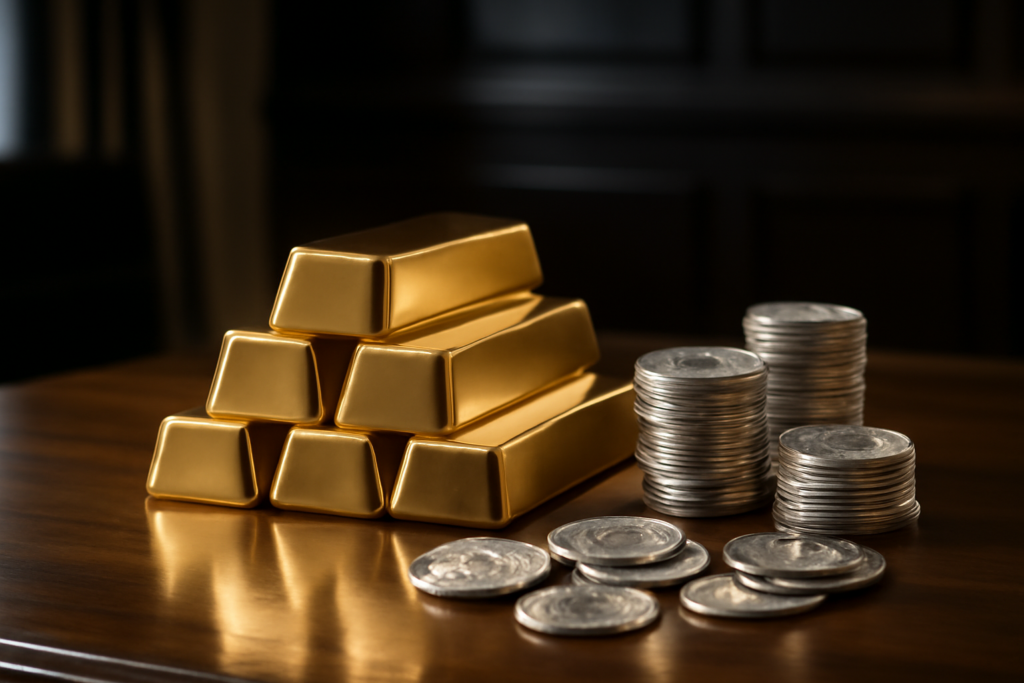
# Are gold and silver in a bubble in 2026?
What the figures, the markets and the facts really say.
*Market analysis • January 2026 • Sarah for Gold & Silver Company*
Is gold in a bubble? Is silver about to collapse?
For several weeks now, this question has come back almost systematically among European savers. Prices have reached historic levels, the media speak of records, and comparisons with past financial bubbles have become frequent.
Yet describing a market as a « bubble » presupposes precise criteria: a disconnection between prices and economic fundamentals, widespread euphoria among the general public and a dynamic fuelled mainly by speculation.
This analysis aims precisely to answer that question, with figures to support it: are gold and silver really in a bubble in 2026, or are we witnessing something else? For context on how far prices have come, our gold price page tracks the live market.
Gold and silver in 2026: real data, a probable scenario and measured foresight
In 2025, the precious metals markets experienced an exceptional dynamic. Gold ended the year up around +65%, reaching record levels above $4,300 an ounce at the annual close, its best yearly performance since the late 1970s. Silver, for its part, posted an even more spectacular advance, with gains close to +140%, trading durably in a range between $70 and $80 an ounce at year end.
These figures mark a major turning point in the perception and use of precious metals worldwide. They can impress, and sometimes worry. But they do not, in themselves, constitute proof of a speculative bubble.
An exceptional but explicable performance
The year 2025 was not marked by irrational euphoria, but by an accumulation of structural factors. Institutional demand remained strong, particularly from central banks and major investors, against a backdrop of questioning of traditional monetary balances.
Gold benefited from an environment in which real interest rates remained low or unstable, public debt continued to grow, and geopolitical tensions strengthened the search for tangible assets. This dynamic is nothing like a mass speculative frenzy: it belongs to a long-term protection strategy, closely tied to gold’s role in preserving purchasing power.
Silver, meanwhile, drew on two powerful drivers. On the one hand, its status as a precious metal, often associated with gold in phases of monetary stress. On the other, structural industrial demand, notably in the energy, electronics and energy-transition technology sectors. Supply, for its part, remained constrained, which amplified price movements.
Why the term « bubble » is inappropriate today
Historically, a bubble forms when the price of an asset moves durably away from its fundamentals, carried by widespread euphoria and the conviction that the rise cannot stop. This pattern is almost always accompanied by a massive influx of the general public, growing recourse to debt and the disappearance of doubt.
The behaviour observed today is very different. The questions asked by savers are cautious, sometimes anxious. Decisions are considered and gradual. The fear of buying « at the top » is omnipresent. This climate of restraint is, historically, the opposite of a bubble environment.
High prices are not the product of collective emotional runaway, but the consequence of a strategic repositioning in the face of lasting economic imbalances.
2026 outlook: what the institutions are saying
At the dawn of 2026, several major financial institutions have published structured scenarios for precious metals. The ranges put forward for gold generally extend between $4,800 and $5,000 an ounce over the year, depending on the evolution of real rates, monetary policy and institutional flows. These projections are not promises, but conditional scenarios, founded on precise macroeconomic assumptions.
Regarding silver, many analyses highlight the persistence of an imbalance between supply and demand. In certain market configurations, levels above $80, or even $100 an ounce, are mentioned, not as a certainty, but as a possible consequence of a structurally tight market.
What could happen next quarter?
After a year of gains as marked as 2025, a consolidation phase appears to be the most probable scenario. Prices may move sideways, with increased volatility, while the market digests the levels reached.
A moderate technical correction, of the order of 5 to 10%, remains possible. This type of movement is frequent in bull markets and does not constitute a reversal signal. It can be amplified by purely technical factors, such as profit-taking or adjustments linked to the major commodity indices.
Conversely, a resurgence of geopolitical or financial tensions could quickly revive safe-haven demand and support new highs, without any prior pullback phase.
What this means for savers
For holders of physical gold and silver, the essential point is to distinguish volatility from rupture. Short-term movements, sometimes spectacular, do not call into question the underlying logic: that of tangible assets used as wealth protection tools in an uncertain environment.
A correction is not a collapse. A consolidation is not a reversal. And a high price is not, in itself, a bubble.
The question is not whether gold and silver can correct in the short term. They can, and they probably will at certain moments.
The real question is whether the economic, monetary and geopolitical imbalances that led to their revaluation have disappeared.
•At this stage, the answer is clearly no.•
Gold and silver do not tell a story of blind speculation, but that of a world re-evaluating its monetary benchmarks and its notion of economic security.
Glossary
Speculative bubble
An excessive rise in prices fuelled by euphoria and speculation, generally followed by a brutal collapse.
Technical correction
A temporary and limited decline in prices within a bull market, without calling the fundamentals into question.
Consolidation
A phase of price stabilisation after a strong rise.
Safe-haven asset
An asset sought after to preserve purchasing power in times of economic or financial uncertainty.
*This article is part of an independent analysis approach, based on observation of the European physical precious metals market and on public, recent and verifiable economic data.*
*Updated on 27 September 2026.*
Frequently asked questions about gold
Is gold in a speculative bubble in 2026?
No, at least not according to the classic criteria used to define a bubble. A speculative bubble requires a durable disconnection between prices and economic fundamentals, widespread euphoria among the general public and a dynamic fuelled mainly by speculation. The behaviour observed today is very different: savers’ questions are cautious, sometimes anxious, decisions are considered and gradual, and the fear of buying at the top is omnipresent. This climate of restraint is, historically, the opposite of a bubble environment. The rise in gold prices is explained by an accumulation of structural factors: sustained institutional demand from central banks, low or unstable real rates, growing public debt and geopolitical tensions strengthening the search for tangible assets. You can follow the live gold price to judge the market for yourself.
Could silver prices collapse after their 2025 surge?
A collapse is not the scenario the fundamentals point to. Silver ended 2025 with gains close to +140%, trading durably between $70 and $80 an ounce, but this advance rests on two powerful drivers: its status as a precious metal in phases of monetary stress, and structural industrial demand from the energy, electronics and energy-transition technology sectors, while supply remains constrained. After such a rise, a consolidation phase or a moderate technical correction of 5 to 10% remains possible, and would even be normal in a bull market. But a correction is not a collapse, and a consolidation is not a reversal. Many analyses highlight a persistent imbalance between supply and demand, with levels above $80, or even $100 an ounce, mentioned in certain market configurations as a possible consequence of a structurally tight market.
What do the major financial institutions forecast for gold in 2026?
At the dawn of 2026, several major financial institutions have published structured scenarios for precious metals. The ranges put forward for gold generally extend between $4,800 and $5,000 an ounce over the year, depending on the evolution of real interest rates, monetary policy and institutional flows. It is important to understand that these projections are not promises: they are conditional scenarios, founded on precise macroeconomic assumptions that can evolve. They reflect, above all, the fact that the professional world does not read the current market as an irrational bubble, but as a strategic repositioning in the face of lasting economic imbalances. For savers wishing to go further, our gold guide sets out the fundamentals of investing in physical metal in a measured and documented way.
Should I sell my physical gold now that prices are at record levels?
That depends entirely on why you hold it, and this article cannot replace advice tailored to your personal situation. What the analysis does show is that a high price is not, in itself, a bubble, and that short-term movements, sometimes spectacular, do not call into question the underlying logic of tangible assets held as wealth protection in an uncertain environment. The real question is whether the economic, monetary and geopolitical imbalances that led to the revaluation of gold and silver have disappeared, and at this stage, the answer is clearly no. If you are considering a sale or a purchase, the team at the agency can review your position with you in complete confidentiality: simply book an appointment at our Dottignies counter.
How can I invest in physical gold and silver without taking speculative risk?
The first protection against speculation is a long-term approach: buying physical metal progressively, with amounts that suit your means, rather than trying to time the market. Physical gold and silver are not instruments of blind speculation; they are tangible assets used as wealth protection tools in an uncertain environment, and their role in preserving purchasing power is documented in our analysis of gold and purchasing power. The second protection is the quality of what you buy: certified bars from a recognised refinery guarantee traceability and liquidity when the time comes to sell. Gold & Silver Company offers a full range of certified gold bars, struck in its own refinery and delivered with their official certificate, so that every purchase rests on verifiable guarantees.