
On Monday 2 November 2026, the Central Bank of Paraguay (BCP) opened resolution proceedings against ueno Bank SA, meaning the takeover, by the regulator, of a failed bank, with a view to an orderly repayment. With the resolution, the accounts of about 3 million customers were frozen. The figure represents nearly half of the country’s 6.5 million inhabitants.
Born as a fintech, ueno had become a mid-sized bank used by more than 60% of Paraguayan adults. The freeze therefore concerned a bank deeply embedded in the country’s financial life. It cut off access to current accounts, transfers and funds used on a national scale.
On 2 November, the resolution turned a banking alert into a national event
A review opened in June had brought to light loans granted to companies linked to the bank’s owners, fragile liquidity and additional provisions to be booked. The file also revealed the central point of the alert: a solvency ratio, posted at 15.01% in March against a legal floor of 12%, that had fallen below half that minimum.
The exposure did not only concern individuals. Between $800 and $850 million was managed on behalf of the State. About $380 million corresponded to the public pension and health fund, the IPS. Public deposits represented nearly 25% of the total. The funds of the national electricity utility ANDE and of the Itaipú dam were also trapped.
The resolution thus placed within the same frame the accounts of millions of customers, the money of public bodies and the questions about the bank’s governance. The procedure was no longer just a regulator’s file: it was becoming an event visible in daily life.
On 4 November, executives and depositors appeared at the same point of the crisis
On Wednesday 4 November, Carlos Carvallo, president of the Central Bank and former president of ueno, resigned at the request of President Santiago Peña. The same day, eight ueno executives, including its president Miguel Vazquez, turned themselves in to the authorities after arrest warrants were issued. Their assets were frozen.
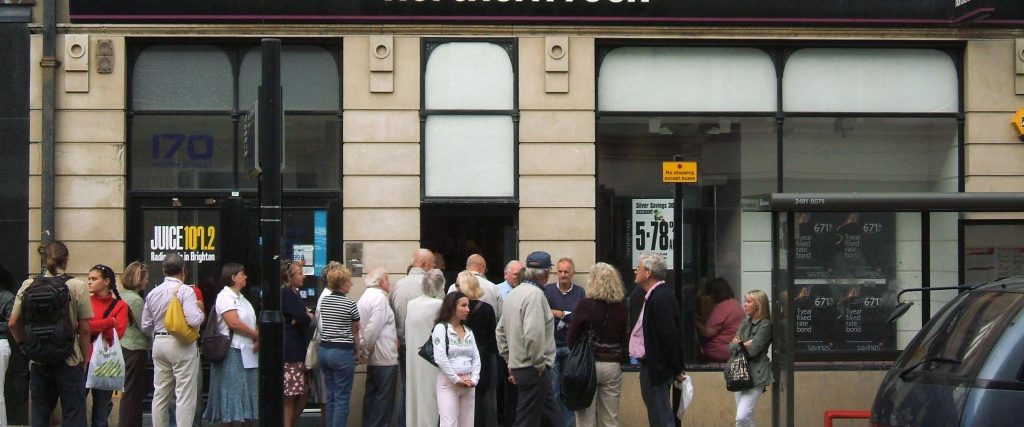
Under a flood of precautionary transfers, several banking apps went down. Depositors queued outside branches in Asunción, while protests took place in the evening. The banking crisis then materialized as unavailable screens, waiting lines and court decisions concerning the executives.
On 5 November, the banking crisis reached the presidency
On Thursday 5 November, the Chamber of Deputies voted on impeachment proceedings tabled the day before. Santiago Peña then announced his resignation in a video recorded at the presidential residence and posted on X. Vice President Pedro Alliana was due to take over.
Markets extended the sequence. The guaraní lost about 5%, at 6,525 to the dollar on Thursday. Sovereign bonds drifted among the worst emerging-market performances, the 2055 maturity shedding 1.8 cents.
The chronology fits in a tight sequence: the resolution of 2 November, the resignation of the Central Bank president on the 4th, the surrender of eight executives the same day and the presidential resignation on the 5th. That succession is what gives the case its political dimension.
For the saver, a bank failure starts with a frozen account
In ueno’s case, the immediate effect for the depositor is the account freeze. Then comes the guarantee mechanism. The Deposit Guarantee Fund covers up to 228.3 million Paraguayan guaranís per person, about $35,700 to $37,000 depending on the rate. The regulator estimates that this ceiling fully protects about 97% of depositors.
The calendar adds a precise date to the wait. The legal payment deadline is set for 17 November, with a possible 15-day extension. The BCP also promised a first payment of up to 10 million Paraguayan guaranís, about $1,500.
The European reference fits in one sentence: in the European Union and in Belgium, the deposit guarantee is capped at 100,000 euros per person per bank.
This mechanism separates access to the account, which can be suspended, from the guarantee, which applies within a set limit, then from the legal calendar that organizes payment. The Paraguayan case makes these steps visible, with a ceiling, a percentage of covered depositors and a reference date.
The regional context provides market reference points
In Brazil, Lula’s re-election on 25 October was followed by a 26.3% drop in one week for Itaú Unibanco’s ADR on Wall Street, down from $9.67 to $7.13. In Argentina, banking ADRs hit their lows of the year: Supervielle was down 46% in 2026, Galicia 40%, BBVA Argentina 37% and Macro 33%. Country risk had moved back above 800 basis points.
In South-Eastern Europe, the Serbian bank Alta Banka had its licence withdrawn on 30 October. These elements place ueno’s week at a moment when several banking and sovereign signals, in South America as in South-Eastern Europe, were observed. They do not alter the mechanics specific to the Paraguayan file: frozen accounts, a capped guarantee and a payment calendar.