
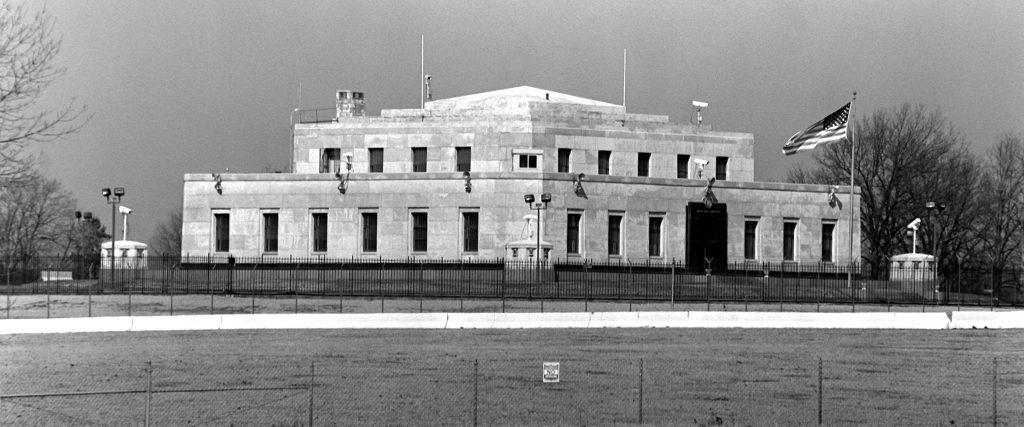
On 9 October 2026, Judy Shelton joins Scott Bessent at the US Treasury. An economist and long-time advocate of anchoring the currency to gold, she revives a rumour that Wall Street knows by heart: could the United States revalue its 8,133 tonnes of gold, still booked at $42.22 an ounce since 1973? The matter touches on US debt, the dollar and, inevitably, the price of an ounce for European savers.
Key points
- 8,133 tonnes of gold, or 261.5 million ounces, held by the United States.
- Booked at the legal price of $42.22 an ounce, frozen since 1973 (Title 31, Section 5117).
- Around $11 billion on the Treasury’s books, $1,000 to $1,100 billion at market prices.
- Only Congress can change that price. No sign of government intent so far, according to Morningstar.
How much is the Fort Knox gold worth? 8,133 tonnes booked at $11 billion
At Fort Knox and in the other federal depositories, the United States holds around 8,133 tonnes of gold. That represents 261.5 million ounces. In late October 2026, an ounce trades at around $4,000. At market prices, this stock would be worth roughly $1,000 to $1,100 billion.
On the Treasury’s books, it weighs in at around $11 billion.
The gap is no accident. It is the product of a rule. While that figure sleeps, total US public debt stands at $40,329 billion as of 14 October 2026, according to Treasury FiscalData, « Debt to the Penny ». The 2026 federal fiscal year, which ended on 30 September, closed with a deficit of $1,992 billion, against $1,775 billion the previous year.
On 28 January 2026, gold hit a record of $5,594.82 an ounce. It has since lost nearly 29%. Two weeks of declines pushed the price below $4,000 on Friday 23 October, its lowest since mid-July. Central banks, according to Morningstar, are still buying; gold ETFs, for their part, recorded outflows in the week of 19 October.
It is in this tension, between a retreating metal and a swelling US balance sheet, that the revaluation rumour has found its voice again. Gold has already overtaken US Treasury bonds in global reserves. Washington, for its part, has still not moved the $42.22 figure.
Why is US gold still booked at $42.22 an ounce?
Why eleven billion, and not a thousand? Because US gold is not marked to market. It is booked at the legal price of $42.22 an ounce, frozen since 1973 by Title 31, Section 5117 of the United States Code.
This is not custom, it is the law. Neither the president, nor the Treasury secretary, nor the Federal Reserve can change this price on their own. Only Congress can. That is the essential lock, too often glossed over by the rumour.
The United States is one of the few major economies that does not regularly revalue its gold reserves at market prices. Germany carried out a one-off budgetary revaluation in 1997-1998, for an effective transfer of around 13 billion marks, below the figure discussed at the time (close to 0.5% of its GDP); its central bank also carries out regular mark-to-market updates.
What is a gold reserve revaluation?
Revaluing, in this language, does not mean selling an ounce. It means changing the figure at which the state books the gold it already owns. No additional bar would appear in the vaults. The gap between $42.22 and the market price, around $4,000 in late October 2026, would create a colossal accounting gain, paid into the Treasury’s general account.
It is precisely this gain, in the region of $1,000 to $1,100 billion, that analysts are debating. A pen, a law, and a balance sheet that changes its face.
1933-1934: when Roosevelt changed the price of gold
The precedent is not theoretical. In 1933-1934, Franklin D. Roosevelt revalued gold from $20.67 to $35 an ounce, through the Gold Reserve Act of 1934.
The move redrew the state’s balance sheet and the role of the dollar. It belongs to another era, that of a still-living gold standard, the Great Depression, and a president who banned the private ownership of gold. The current parallel is therefore not a copy. It serves as a reminder.
The legal price of US gold has moved before, by law, and that move had consequences for the currency. Scott Bessent, the current Treasury secretary, has spoken of a « new Bretton Woods moment ». The phrase fires the imagination. On its own, it does not say what Washington will do with Fort Knox.
Between $20.67 and $35, the ounce gained nearly 70% on paper. Between $42.22 and $4,000, the gap is no longer of the same order. Hence the fascination. Hence, too, the caution of those who point out that a stroke of the pen creates no real wealth.
Judy Shelton at the Treasury, the October 2026 development
On 9 October 2026, Judy Shelton was appointed adviser to Scott Bessent at the Treasury, on exchange rate policy, with a particular focus on China. The post does not require a Senate vote.
Shelton is a long-time advocate of anchoring the currency to gold. She devised the concept of « Treasury Trust Bonds »: 50-year bonds redeemable at maturity, at the holder’s choice, in dollars or in a fixed weight of gold. Her initial target was a first issue on 4 July 2026, for the 250th anniversary of the United States. That date passed without an issue.
This bond route does not require touching the legal price of $42.22. It bypasses Congress on this specific point, while reintroducing gold into the architecture of the debt. An appointment, a tool already designed, a missed symbolic date: markets needed no more than that to reread the US balance sheet.
It is not yet a law. It is a name, a vocabulary, a hypothesis that is no longer exotic.
What Scott Bessent said, and what he did not say
In February 2025, Scott Bessent said he wanted to « monetise the asset side of the US balance sheet for the American people ». Seventeen days later, he told Bloomberg that revaluing gold was « not what he had in mind ». The idea of allocating this stock to a sovereign wealth fund had also been ruled out as early as February 2025.
In July 2026, on Fox, he stated that the Fort Knox gold was indeed present and accounted for.
These statements do not contradict each other, but they leave an open space. It is in this space that analysts now place Judy Shelton. Morningstar quotes Peter Kinsella of Union Bancaire Privée, who describes the revaluation of US gold reserves as « the most pressing upside risk » for gold in the coming months. In this analysis, a revaluation at market prices would implicitly devalue the dollar against gold and revive the « debasement trade » of 2025.
Morningstar notes that there is currently no sign of government intent. The distinction matters. A rumour is not a decision. An upside risk is not a timetable.
What would a US gold revaluation change for debt, the dollar and the price?
The first scenario remains no decision. That is the one Morningstar describes, noting that no sign of government intent has appeared to date.
Ronald-Peter Stöferle, a fund manager at Incrementum AG and co-author of the « In Gold We Trust » report, put the probability of a US revaluation at 10-15%. He now assesses it at more than 50% and expects a move before the midterm elections. That is his judgement, not an official forecast.
Singapore’s Business Times describes revaluation as an unconventional tool at the Treasury’s disposal. A gain of $1,100 billion, around 3% of GDP, paid into the Treasury’s general account, would make it possible to reduce long-dated bond issuance, ease yields, or expand a debt buyback programme. It would not, however, erase the $40,329 billion of debt.
Yields have already spoken. The US 10-year touched 5.35% and the 30-year 5.72% on 7 October 2026, 24-year highs. The 10-year eased towards 5.09% on 16 October. The link between gold, rates and the dollar is not a seminar abstraction.
An op-ed in Eurasia Review, dated 10 October 2026, pushes the thought experiment as far as $155,000 an ounce. The reserves would then be worth $40,000 billion, enough in theory to repay the entire debt. The author stresses that this creates no real wealth and would produce unprecedented inflation. It is a paper exercise, not a plan.
The context does not help file the matter under science fiction. War between the United States and Iran since late February 2026, high oil prices, persistent inflation. The Fed, chaired by Kevin Warsh, raised its rates by 25 basis points on 16 September 2026, the first increase since July 2023. The meeting of 27 and 28 October 2026 is expected to leave rates unchanged, with markets betting on a rise in December, at 75-92%.
Despite the fall in the ounce, when gold falls, central banks keep buying, according to Morningstar. The backdrop is tense. It is not proof.
What this changes for a Belgian or French saver
For an individual in Brussels, Lille or Dottignies, Fort Knox is not a distant vault. It is a signal about how states treat the gold they hold, and therefore about the role the metal still plays in the system.
At Gold & Silver Company, we see client questions shifting. Less « will it go up tomorrow », more « what does the US balance sheet really say ». The recent fall does not erase the gap between Washington’s legal price and the price at which a saver buys a coin or a bar.
A revaluation, if Congress were ever to vote one, would guarantee nothing about the price of an ounce the next day, nor about the value of assets denominated in euros. Morningstar ranks it among the upside risks, while noting the current absence of any sign of intent. Stöferle is more convinced. The gap between these readings is already information in itself.
What concretely changes is the conversation. Reading a price, weighing a bar, distinguishing the political debate from physical metal becomes a useful practice once again, not a panic reflex. The Dottignies branch, an independent neo-foundry, a refinery accredited by the Royal Mint of Belgium, welcomes these questions without an emergency timetable. Gold circulates there in a short European circuit, recycled. A weight, a fineness, a market price.
Frequently asked questions about the revaluation of US gold
If Washington revalues its gold, will my bar rise straight away?
No. A revaluation would first change an accounting figure, the legal price of $42.22 an ounce at which Washington books its 8,133 tonnes. A Treasury appointment and an analyst’s opinion do not constitute a US decision. The analysis quoted by Morningstar sees it as the most pressing upside risk for gold, because it would implicitly devalue the dollar against the metal; the article notes the current absence of any sign of intent. Your bar, meanwhile, trades at the market price, around $4,000 an ounce in late October 2026. At the Dottignies branch, a free appraisal connects this debate to the real weight of what you hold, without an emergency timetable.
Can the president change the price of US gold with a snap of the fingers?
No. Only Congress can change the legal price of $42.22, frozen since 1973 by Title 31, Section 5117. Neither the president, nor Scott Bessent, nor the Fed has that power. Judy Shelton, appointed on 9 October 2026, has however devised another route: 50-year Treasury Trust Bonds, redeemable in dollars or in a weight of gold, without touching that legal price. The 4 July 2026 target passed without an issue. For a saver, the essentials lie elsewhere: understanding who decides, and what the market price already says. That can be done, quite simply, over a coin or a bar, at the branch.
Gold has fallen a lot since January, should I worry about what I own?
The ounce touched $5,594.82 on 28 January 2026, then fell by nearly 29%. On 23 October, it dropped below $4,000, its lowest since mid-July. In late October, it hovers around $4,000. This fall has not stopped central banks, which keep buying, according to Morningstar; gold ETFs recorded outflows in the week of 19 October. The question is not to judge a single week. It is to understand the price, the spread and the premium of what you hold. A reading at Dottignies, free of charge, puts the figures back in order, with no injunction to buy.
And the euro in all this, I am in Belgium, not New York?
The debate is American. Its effects, if any, would pass through the dollar. The analysis quoted by Morningstar notes that a revaluation at market prices would implicitly devalue the dollar against gold. US yields, at 5.35% on the 10-year on 7 October, then 5.09% on the 16th, already show a nervous bond market. For a saver in Brussels or Lille, physical gold remains a weight, not a bet on Congress. The Dottignies branch works with recycled gold in a short circuit. Prices are read together there. No Washington scenario is sold there.
Can I come to Dottignies just to understand, without buying anything?
Yes. The Dottignies branch welcomes visitors to read a price, weigh a coin, explain a bar. The head office is that of an independent neo-foundry, a refinery accredited by the Royal Mint of Belgium. Many visitors come simply to check the weight and fineness of an inherited object, with no plan to sell or buy. 9 October revived questions about Fort Knox; that does not turn an appointment into a buying decision, and a US Treasury appointment changes nothing about what your coin weighs. Getting in touch is enough. The appraisal is free. You leave with a reading, not an injunction.
How much is the Fort Knox gold really worth today?
On the Treasury’s books: around $11 billion, at the legal price of $42.22 an ounce frozen in 1973. At market prices: between $1,000 and $1,100 billion, for 8,133 tonnes, or 261.5 million ounces. The gap is down to accounting, not the metal. Scott Bessent confirmed it on Fox in July 2026: the Fort Knox gold is « present and accounted for », with no new public audit announced since. Changing the booked value would be a matter for Congress alone. In the meantime, it is the market price that states the real price of an ounce, and it can be read every day, without debate.
Anaïs, Head of Production at Gold & Silver Company
—