
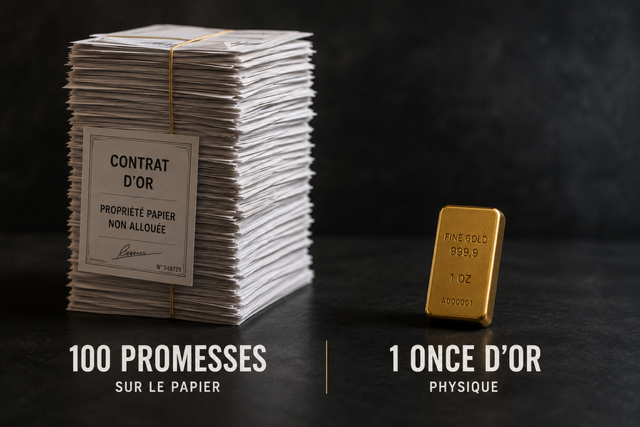
# Paper gold: the gold you think you own may not exist
On paper, roughly a hundred times more gold circulates today than actually sleeps in the vaults
The gold price has just lived through a wild year: fifty-three all-time records in 2025, a peak beyond 4,500 dollars an ounce in the spring, then a pause that brings the metal back to around 4,150 dollars an ounce in this late June 2026, or nearly 116 euros per gram. During the rush, hundreds of billions poured into gold. But most of it never touched a single bar.
In 2025, gold-backed exchange-traded funds attracted a record 89 billion dollars and their holdings reached an all-time high of 4,025 tonnes, according to the World Gold Council. Gold, really? On paper, yes.
The real question is not how much your gold is worth. It is whether it exists.
A hundred promises for one ounce of metal
When you buy gold through a futures contract, an unallocated account or most derivative products, you are not buying metal. You are buying a promise: that gold will be delivered to you if you ever claim it. The problem is that far more promises have been sold than there is metal available. On New York’s COMEX, the main pricing venue, there were recently around 36 million ounces actually available for delivery, against nearly 380 million ounces of contracts in circulation. Market estimates put the ratio of paper gold to physical gold at more than a hundred to one. In other words: if only a fraction of holders claimed the metal at the same time, there would not be enough to go around.
The signal the City would rather keep quiet
This is not a theory. In 2025, delivery times for gold from the Bank of England’s vaults, the heart of the London market, stretched to four and even eight weeks, against two to three days in normal times. A technical detail? More like a confession. The whole system rests on one quiet bet: that virtually all buyers will content themselves with a line on a screen and never ask to touch their gold. The day the queue lengthens at the counter, days become weeks. And nobody, in the markets, likes to explain why.
Central banks, for their part, demand the metal
While paper is being sold to private individuals, the best-informed buyers on the planet are doing exactly the opposite. In 2025, central banks acquired 863 tonnes of gold, their fourth-largest volume ever recorded, well above the average of the previous decade. Poland led the way with 102 tonnes added. According to the World Gold Council’s annual survey, a record proportion of 43% plan to strengthen their reserves further. Above all, they do not settle for promises: they want metal that is allocated, identified and, increasingly often, repatriated into their own vaults. When the institutions that print currency prefer gold you can touch, the nuance is worth dwelling on.
Paper gold is not a scam (but it is not gold)
Let us be fair: exchange-traded funds and derivative products are not a fraud. They are liquid, can be bought in a second, require neither vault nor insurance, and suit perfectly anyone who wants quick exposure to the gold price. Most of the time, the mechanism works without a hitch. The danger is not that they exist. It is mistaking a promise on a screen for metal in your hands, and believing you will be able to turn one into the other on the day everyone wants to. As early as February 2025, the world’s largest gold fund held around 870 tonnes of metal against potential obligations exceeding 1,100 tonnes. And the European Central Bank has itself warned: exposure to gold derivatives in the euro area passed one trillion euros in 2025, most of it traded over the counter, with no central clearing house.
Owning, or holding a promise
That is the whole difference. An investment coin in your hand, a 50 or 100 gram gold bar stored in a safe deposit box in your name: that is gold that depends on nobody’s solvency. A line on an application is a claim on a counterparty that, in turn, depends on a thousand others.
The same reasoning applies to silver, where the gap between the paper market and the physical stock is even tighter. Nothing obliges you to choose only one side: paper for flexibility, physical for security. The rest is a question to ask yourself before, not after. What do you actually own? Metal, or the promise of metal?
Sarah, Managing Director
Frequently asked questions about gold
What exactly is the difference between paper gold and physical gold?
Paper gold is a promise: a futures contract, an unallocated account, a certificate or an exchange-traded product that almost never ends in a delivery. Physical gold is the metal itself, the bar or the investment coin you can hold in your hand. The distinction matters because far more promises circulate than metal exists: market estimates put the ratio of paper gold to physical gold at more than a hundred to one, and New York’s COMEX recently counted around 36 million ounces available for delivery against nearly 380 million ounces of outstanding contracts. As long as nobody asks for delivery, the mechanism holds. The day a fraction of holders claims the metal at the same time, the promise shows its limits. Owning physical gold means owning an asset that depends on nobody’s solvency.
Can I convert my paper gold into physical metal whenever I want?
In theory, certain contracts provide for delivery. In practice, almost none of them end that way, and the system is not built for it. In 2025, delivery times from the Bank of England’s vaults, the heart of the London market, stretched to four and even eight weeks, against two to three days in normal times: the first concrete sign that a simultaneous request for metal overwhelms the machine. Most exchange-traded products do not allow private holders to withdraw metal at all, or only from very large amounts and through authorised intermediaries. If your objective is to hold the metal one day, the shortest route is to buy it directly: certified bars and investment coins exist precisely for that, allocated, identified and immediately yours.
Is paper gold a scam?
No, and it is important to say so plainly. Exchange-traded funds and derivative products are legal, liquid instruments, buyable in a second, requiring neither vault nor insurance, and they suit anyone seeking quick exposure to the gold price. Most of the time, the mechanism works without a hitch. The real danger is confusion: mistaking a promise on a screen for metal in your hands, and believing you will be able to transform one into the other on the day everyone wants to. The figures invite caution. In February 2025, the world’s largest gold fund held around 870 tonnes of metal against potential obligations exceeding 1,100 tonnes, and the European Central Bank has warned that exposure to gold derivatives in the euro area passed one trillion euros, mostly traded over the counter.
Why are central banks buying physical gold rather than paper gold?
Because the institutions that print currency know the difference between a promise and a bar. In 2025, central banks acquired 863 tonnes of gold, their fourth-largest volume ever recorded, well above the average of the previous decade, and Poland alone added 102 tonnes. According to the World Gold Council’s annual survey, a record proportion of 43% plan to strengthen their reserves further. What matters most is how they buy: they demand metal that is allocated, identified and, increasingly often, repatriated into their own vaults, on their own soil. They want no counterparty between them and their gold. When the best-informed buyers on the planet refuse paper and demand delivery, private savers are entitled to draw their own conclusions about what it truly means to own gold.
How can I own physical gold safely, concretely?
Physical ownership rests on three simple principles: a real product, a clear title, a safe place. The real product means certified gold bars and recognised investment coins, tested and weighed in front of you at the counter. The clear title means an invoice in your name, detailing weight, purity and price, so that your ownership is never in doubt. The safe place means either your own arrangements or a safe deposit box rented in your name. The simplest way to start is to book an appointment at the agency in Dottignies: the products are presented physically, the pricing is broken down line by line against the live market, and you leave with metal that depends on nobody’s promise.
*Updated on 26 September 2026.*