
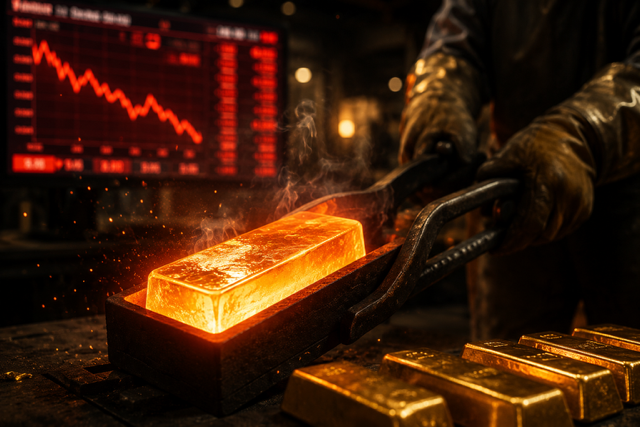
# When everyone panics, we melt
4,530 dollars an ounce of gold. Minus 4% in five days. The headlines scream catastrophe.
Here, in the foundry, the mood is entirely different. The furnaces are running. Orders keep coming in. The clatter of moulds, the smell of hot metal, the gold bars coming out one by one: here, we do not see a crisis. We see perhaps one of those moments that many will look back on differently in a few years. Because there is a fundamental difference between staring at a red chart on a screen and holding a bar in your hand. The chart tells you to run. The bar, for its part, has not moved by a single gram.
Welcome inside the mind of a foundry when the gold price corrects.
What the figures do not tell you
Yes, the ounce of gold has lost nearly 19% since its record of 5,589 dollars in January. Yes, American inflation is picking up again, with the strongest rise in consumer prices since 2023 and the strongest rise in producer prices since 2022. Yes, the Fed will not cut rates this year, the market is now convinced of it. All of this, you have already read everywhere. What nobody tells you is what is happening on the other side of the counter.
Our most experienced clients, those who have been buying since 2018, 2019, are not calling to sell. They are calling to ask: « Do you still have 100-gram bars in stock? » The phone rings more on days when the gold market corrects than on record days. It is counter-intuitive. Yet it is exactly what we observe.
Poland buys 31 tonnes. Private investors count in grams.
It is perhaps the most telling statistic of the quarter. In the first quarter of 2026, central banks bought 244 tonnes of gold. Thirty-seven billion dollars. An absolute record in value terms. Poland alone added 31 tonnes to its vaults, bringing its reserves to 582 tonnes.
Uzbekistan: 25 tonnes. China: 7 additional tonnes, discreetly. And 68% of the world’s central banks plan to buy even more this year.
These institutions do not trade on emotion. They do not stare at candlestick charts at three in the morning. They think in decades, in sovereignty, in resilience. When the National Bank of Poland buys gold while the gold price is falling, it is not making a mistake, it is doing its shopping at a discount. For them, physical gold is not a speculative investment. It is a sovereign safe haven.
Silver: the unloved metal that could surprise you
Meanwhile, silver has taken an even harder slap: minus 6% on Friday, falling back below 79 dollars after flirting with 85 dollars a few days earlier. The gold/silver ratio dropped to 55, a historically low level meaning that silver has appreciated strongly against gold over recent months. UBS cut its investment demand forecast from 400 to 300 million ounces. The supply deficit is melting away like snow in the sun, from 300 to 60-70 million ounces.
On paper, that is negative. But in our workshop, we see something else. Even at elevated levels relative to gold, silver retains industrial fundamentals nobody can ignore: solar panels, electronics, medicine. And above all, every correction brings back buyers whom the prices of recent months had discouraged. The metal is expensive in relative terms. Structurally, demand is not weakening.
The Sino-American truce: the calm before what?
Washington and Beijing shook hands on 10 and 11 May. The dollar rebounded. Precious metals mechanically suffered. Analysts brought out their favourite word again: « consolidation ». Let us be honest: nobody in this foundry believes the trade tensions are settled. A truce is by definition temporary. And when markets remember that detail, they will look for a refuge again. Guess which one.
J.P. Morgan and Goldman Sachs, incidentally, are maintaining their target of 5,000 dollars an ounce of gold by the end of 2026. Not because they are optimistic by nature, but because the fundamentals have not changed.
What we would say to someone walking through the door today
If you walk into Gold & Silver Company this week asking « is this the right time to buy gold? », here is what we will tell you: we do not predict prices. Nobody can. But we know how to read a context. Inflation is resisting. Central banks are accumulating. Geopolitical tensions do not disappear with a handshake. And the current range of 4,380 to 5,100 dollars offers something rare: an entry point after a 16% correction in a structurally bullish market.
Buying physical gold in Belgium, whether gold coins or gold bars, is not betting on a price. It is deciding that your wealth deserves something no algorithm can erase, no central bank can print, and no crisis can dematerialise.
At Gold & Silver Company, we track these dynamics in real time to offer you the best buying and selling conditions, with full transparency on prices and a technical expertise that few players in Europe can match. If you would like to understand how to position precious metals within your wealth strategy, our teams are available for a no-obligation conversation, at the agency or through an appointment.
Anaïs, Gold Broker & Wealth Manager
*Updated on 26 September 2026.*
Frequently asked questions about gold
Why do experienced investors buy gold during a correction?
Because a correction changes the entry point, not the fundamentals. Our most experienced clients, those who have been buying since 2018 and 2019, do not call to sell when the price falls: they call to ask whether 100-gram bars are still in stock. They know that inflation is resisting, that central banks are accumulating, and that a 16% correction inside a structurally bullish market is an opportunity rather than a threat. The phone rings more at the agency on correction days than on record days, which is counter-intuitive but consistent: seasoned buyers measure their wealth in ounces, not in screen colours. A red chart tells you to run; the bar in your hand has not moved by a single gram, and that is precisely the point of holding physical metal through volatile periods.
How much gold did central banks buy in the first quarter of 2026?
Central banks bought 244 tonnes of gold in the first quarter of 2026, worth thirty-seven billion dollars, an absolute record in value terms. Poland alone added 31 tonnes to its vaults, bringing its reserves to 582 tonnes, while Uzbekistan bought 25 tonnes and China added 7 more discreetly. Most telling of all, 68% of the world’s central banks plan to buy even more this year. These institutions do not trade on emotion or watch candlestick charts at three in the morning: they think in decades, in sovereignty, in resilience. When a central bank buys gold while the price is falling, it is not making a mistake, it is shopping at a discount. For sovereign institutions, physical gold is not a speculative investment but a refuge that no monetary policy can dilute.
Should you worry about silver after its recent fall?
Silver has indeed taken a harder slap than gold: minus 6% in a single Friday session, falling back below 79 dollars after flirting with 85 dollars a few days earlier, while UBS cut its investment demand forecast from 400 to 300 million ounces and the supply deficit shrank from 300 to 60-70 million ounces. On paper, that reads negatively. In our workshop, we see something else. The gold/silver ratio has fallen to 55, a historically low level, meaning silver has already appreciated strongly against gold, and its industrial fundamentals remain intact: solar panels, electronics, medicine. Every correction brings back buyers whom recent prices had discouraged, and structurally, demand is not weakening. Silver is expensive in relative terms today, but its long-term fundamentals have not changed with a single volatile week.
What does the Sino-American truce mean for the gold price?
The handshake between Washington and Beijing on 10 and 11 May pushed the dollar higher and mechanically weighed on precious metals, which analysts promptly labelled a « consolidation ». Let us be honest: nobody in our foundry believes the trade tensions are settled, because a truce is by definition temporary. When markets remember that detail, they will look for a refuge again, and history suggests which one. J.P. Morgan and Goldman Sachs are maintaining their target of 5,000 dollars an ounce by the end of 2026, not out of natural optimism but because the fundamentals have not changed: inflation is resisting, central banks are accumulating, and geopolitical tensions do not disappear with a signature. A truce pauses the narrative; it does not rewrite it. For patient holders of physical metal, that distinction is everything.
Is now a good time to buy physical gold in Belgium?
We do not predict prices, and nobody honestly can. What we can do is read a context. Inflation is resisting, central banks are accumulating at a record pace, geopolitical tensions persist despite diplomatic handshakes, and the current range of 4,380 to 5,100 dollars offers something rare: an entry point after a 16% correction in a structurally bullish market. Buying physical gold, whether gold coins or certified gold bars, is not betting on a price. It is deciding that your wealth deserves something no algorithm can erase, no central bank can print, and no crisis can dematerialise. If you are considering a purchase, the question is less about timing the exact low than about deciding which share of your assets you want to shelter from monetary erosion over the long term.
Where can you buy and sell gold safely during a market correction?
Physical gold should be bought and sold through an established professional who verifies the metal, issues a certificate and provides a compliant invoice for every transaction. Gold & Silver Company, a refinery and precious metals dealer based in Dottignies-Mouscron, tracks market dynamics in real time to offer the best buying and selling conditions, with full transparency on prices and a technical expertise few European players can match. During corrections, our teams are available at the agency for a no-obligation conversation about your situation, whether you want to sell your gold in Belgium at a fair price or position physical metal within your wealth strategy. You can book an appointment to discuss formats, quantities and timing with an advisor, at your own pace, without pressure.